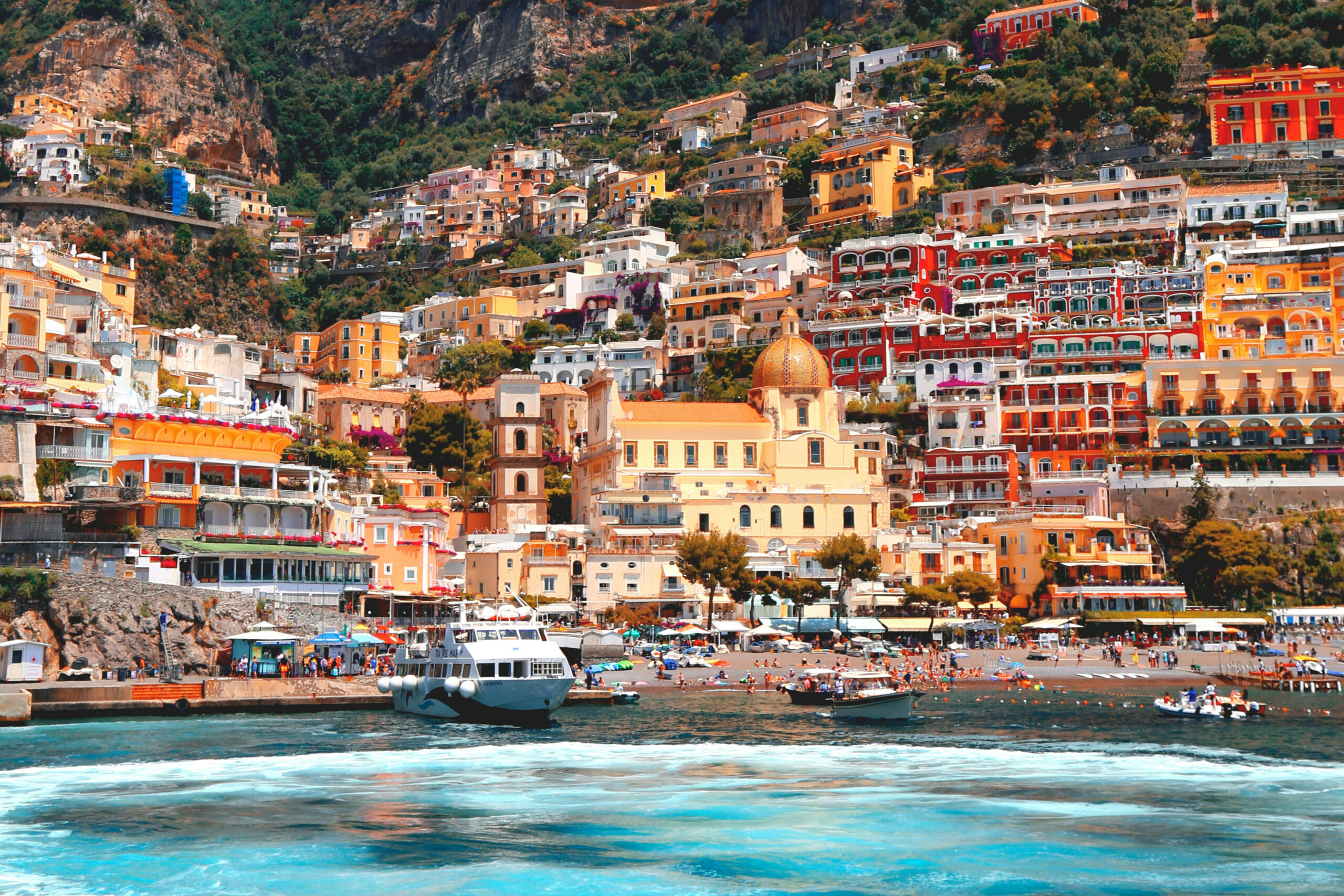
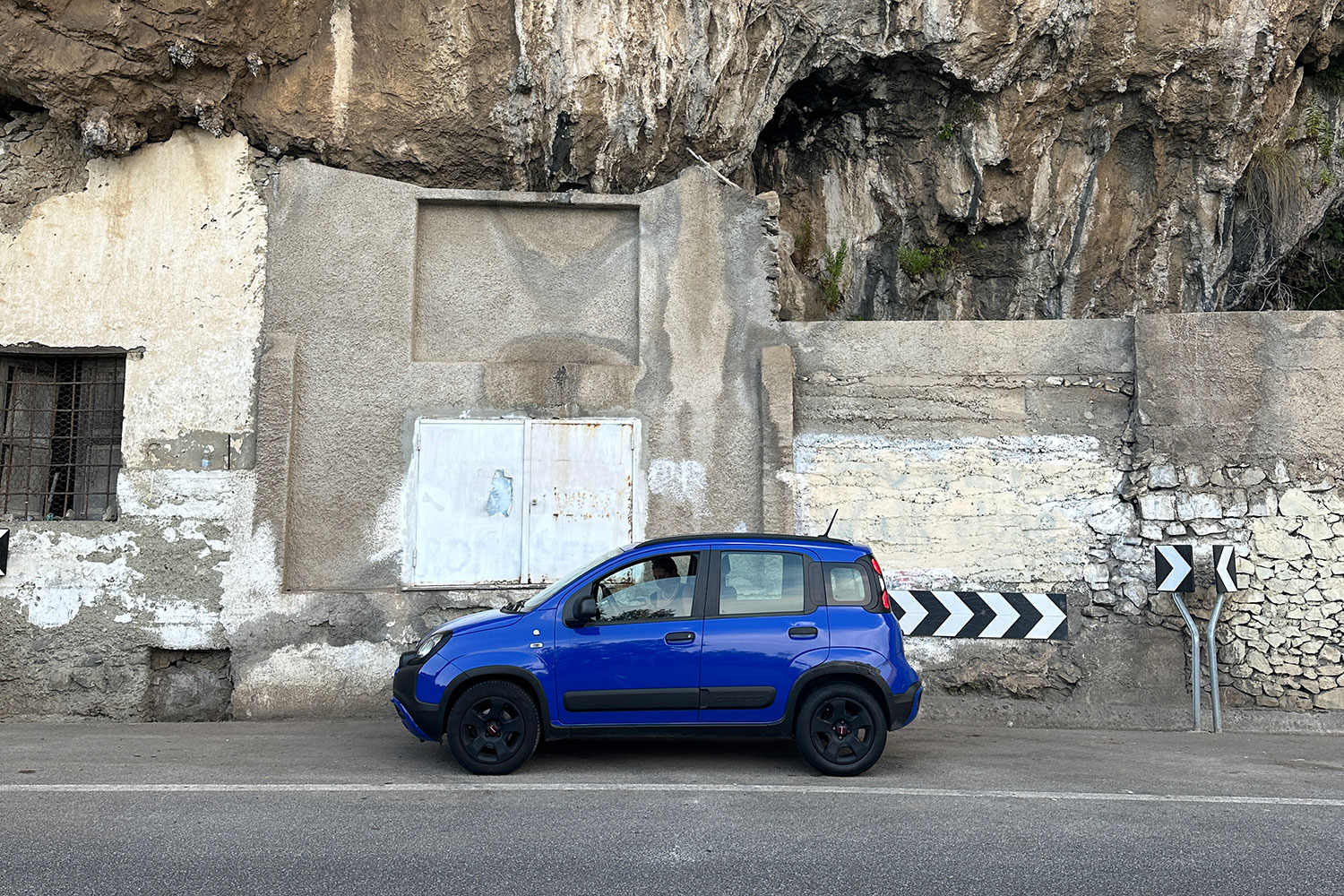
Parking on the Amalfi Coast is one of those practical details worth sorting out before the road begins to curl around the cliffs. The sea opens beside you, Positano drops towards the water, Amalfi appears around the next bend — and suddenly where you leave the car matters almost as much as where you are going.
Parking here is geography translated into euros. These towns have cliffs, ports, medieval streets, churches and lemon terraces. Flat ground is the rare commodity.
This guide explains where to park on the Amalfi Coast in 2026, with current prices, named garages, street-parking advice, Google Maps links and practical choices for Positano, Amalfi, Ravello, Praiano, Maiori, Minori and Vietri sul Mare.
The parking plan in 30 seconds
How parking on the Amalfi Coast actually works
Italy gives you a useful visual shortcut before you even read the sign.
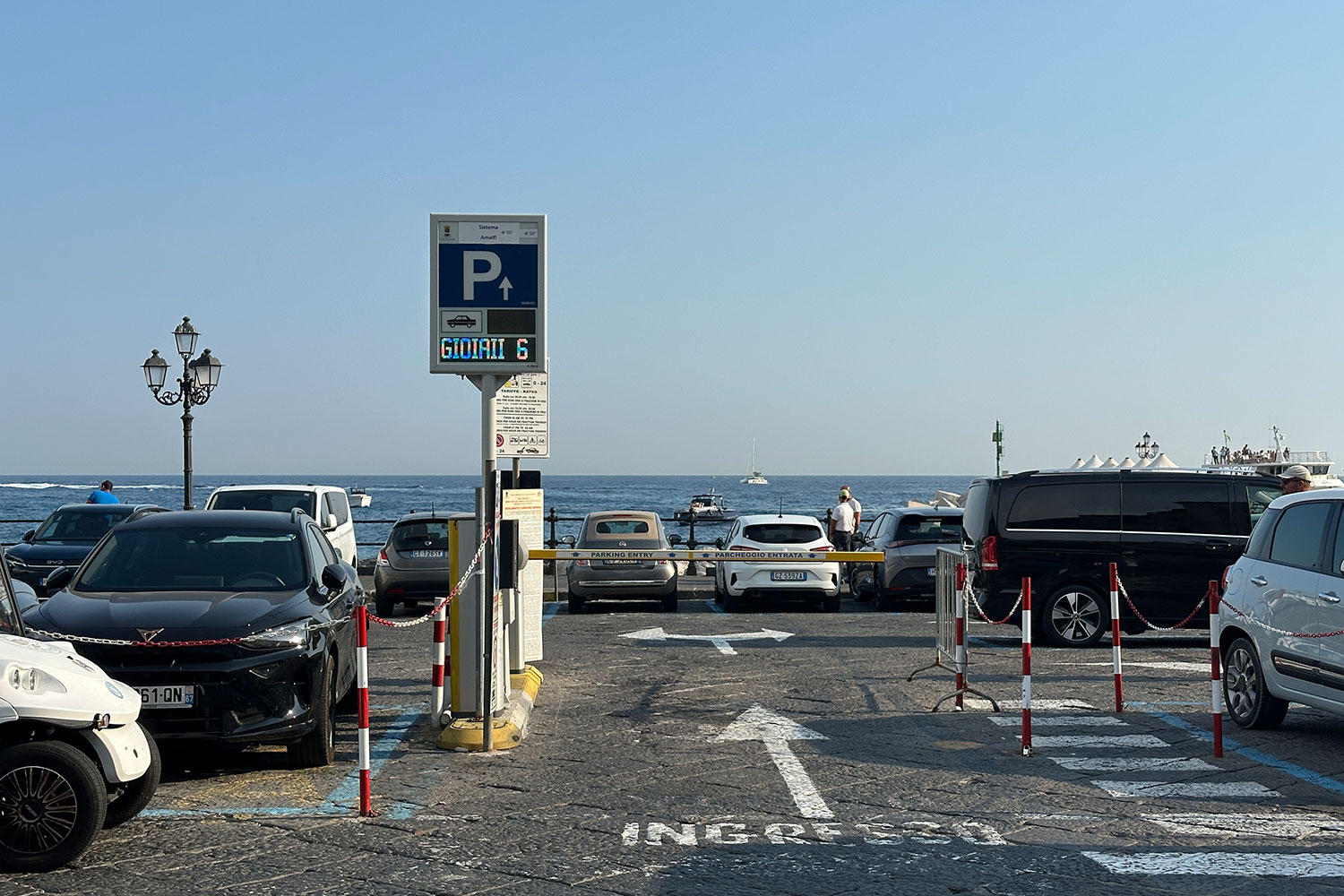
Blue lines — strisce blu — indicate paid parking. Look for the nearby sign or meter for the operating hours and current tariff.
White lines generally indicate free parking, although local restrictions can reserve individual areas or introduce time limits. On the Amalfi Coast, the vertical road sign beside the space is the final word.
Yellow lines mark reserved spaces for specific authorised users or services.
The second category visitors use constantly here is private and municipal garages. In the steepest towns, they are often far more useful than circling for street parking.
One small habit makes the whole process easier: when you see a suitable garage on your route, treat it as the destination. The extra kilometre spent searching for a cheaper space can become several kilometres once Positano’s one-way streets and the SS163 start deciding your route for you.
The experience of parking on the Amalfi Coast changes considerably from town to town. Positano rewards advance planning; Amalfi offers several substantial public options; farther east, Maiori and Vietri give drivers much more breathing room.
Parking in Positano
Positano is where the Amalfi Coast’s parking problem becomes easiest to understand.
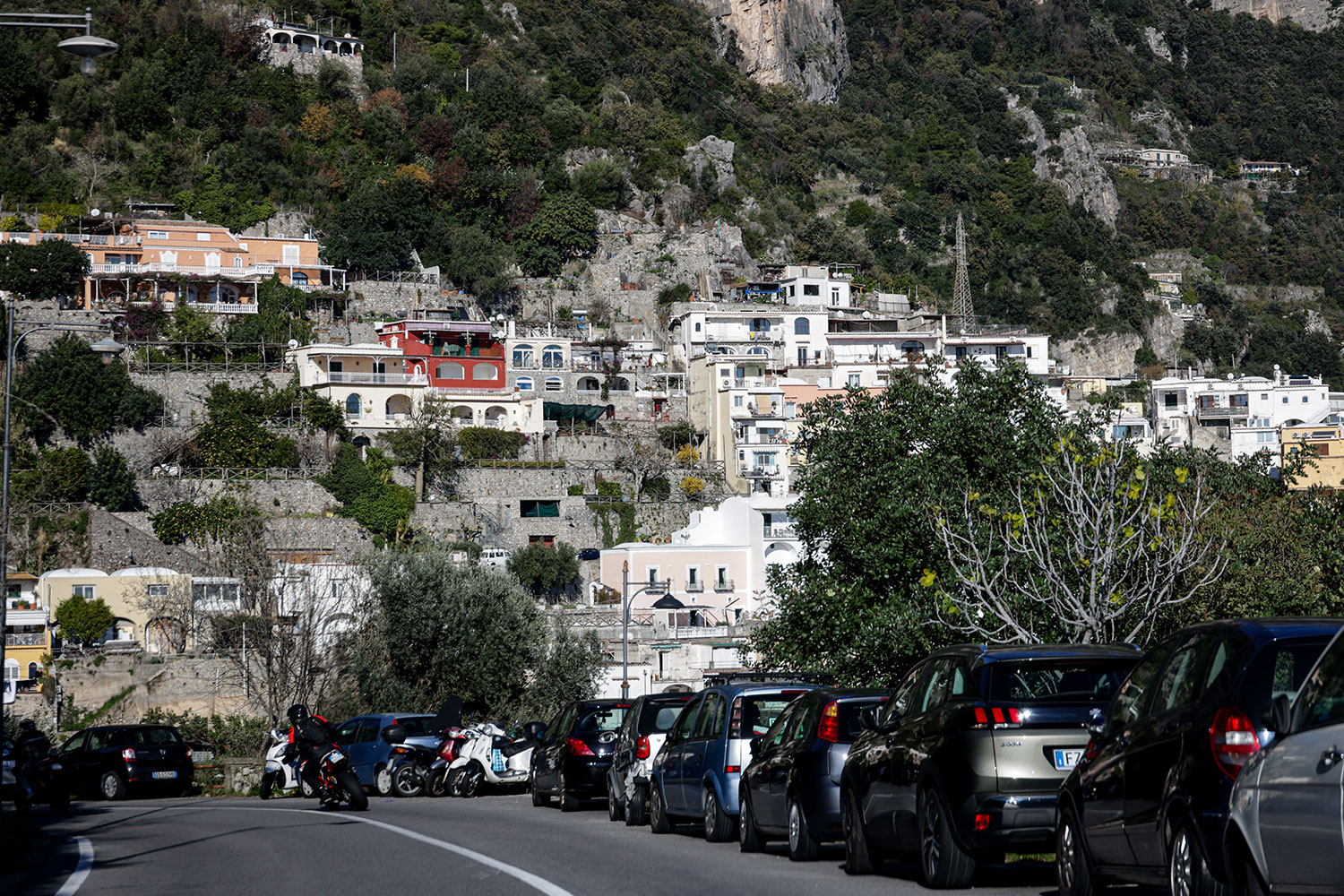
The town drops almost vertically from the SS163 towards the sea. There is little flat ground, the road through the centre is narrow and mostly one-way, and the closer you get to the pedestrian centre, the more valuable every square metre becomes.
For a day visit, I would plan around a private garage rather than arriving with hopes of finding a street space.
The two most useful central options are Parking Di Gennaro and Mandara.
📍 Open Parking Di Gennaro in Google Maps ↗
📍 Open Mandara Parking in Google Maps ↗
Both sit along the road descending from the SS163 towards central Positano, putting you within walking distance of Piazza dei Mulini, the pedestrian lanes and Spiaggia Grande.
Central private parking currently costs roughly €8–10 per hour, with rates varying by garage, time of day and vehicle size. Larger cars and SUVs can cost more. In July and August, reserving ahead is sensible; from May through September, arriving before 09:00 also gives you a noticeably better chance of finding space.
The current Positano.com parking guide is a useful local reference for seasonal parking conditions and typical prices.
Street parking in Positano
There are blue-line paid spaces along some of the roads through town, currently around €3 per hour.
They are the bargain — finding one is the difficult part.
During summer, central blue-line spaces often disappear early in the day. White and yellow spaces around central Positano are largely reserved for residents and authorised vehicles, so always read the sign beside the space before leaving the car.
Free parking exists farther uphill in Montepertuso and Nocelle, but those villages sit well above central Positano. From there, you continue by local bus or on foot.
That can work beautifully when Montepertuso or Nocelle is already part of your day. For a simple visit to central Positano, it turns parking into another journey.
The useful rule here is simple: for Positano, decide where the car will go before you arrive. A reserved garage costs more, but it lets you step out of the car and begin the part of Positano you actually came for.
Know exactly where to park before you get there.
Save the one-page cheat sheet with the best parking options, backup places, typical prices and direct Google Maps links for the main Amalfi Coast towns.
Parking in Amalfi
Amalfi is unusually kind to drivers by Amalfi Coast standards.
The road arrives between mountain and sea, then opens almost directly onto the harbour and historic centre. Several public parking areas sit within an easy walk of Piazza Flavio Gioia, and — unusually for the coast — you can check available parking spaces in real time before you arrive.
That official Visit Amalfi page is the one worth keeping open: it brings together live parking availability, the main car parks, access information and practical transport details in one place.
For most visitors, Berma and Luna Rossa are the two names worth knowing first.
Berma
For a straightforward visit to Amalfi itself, Berma is the most natural place to start.
It is Amalfi’s largest outdoor parking area, stretched along the outer harbour breakwater at the end of Lungomare dei Cavalieri. Once you step out of the car, you are already beside the sea. Piazza Flavio Gioia is a short, flat walk away, and the cathedral appears a few minutes farther into town.
There is something pleasantly simple about arriving this way: park beside the boats, follow the waterfront and let Amalfi unfold ahead of you.
Berma is reserved for cars and has automated access.
From April 1 to November 5, 2026, non-residents currently pay:
09:00–19:00 — €5 per hour
19:01–08:59 — €4 per hour
During the daytime period, the first two hours each carry an additional €2 surcharge. In practice, those first two daytime hours currently cost €7 each.
For a few hours around the cathedral, harbour and historic centre, Berma would be my first choice whenever live availability shows spaces.
Luna Rossa
Luna Rossa feels completely different.
📍 Open Luna Rossa in Google Maps ↗
The multi-storey garage is carved into the rock at the eastern entrance to Amalfi, beside the pedestrian tunnel connecting Amalfi with Atrani. It has 170 car spaces and 30 spaces for motorcycles and scooters.
Its position makes it especially useful when you want to combine the two towns. Park once, walk into Amalfi in one direction and continue through the tunnel towards Atrani in the other.
Luna Rossa is also the natural choice for overnight or multi-day parking.
Vehicles powered by LPG or methane and vehicles taller than two metres use alternative parking arrangements.
Its standard 2026 hourly rates match Berma: €5 per hour during the main daytime period and €4 overnight, with the same first-two-hour daytime surcharge.
For Amalfi + Atrani, or when leaving the car overnight, Luna Rossa makes more sense than Berma.
Darsena
Darsena is the small seaside parking area tucked between the harbour walls beside Piazza Flavio Gioia.
📍 Open Darsena in Google Maps ↗
Its location is hard to beat. Once parked, you are essentially at the entrance to Amalfi’s historic centre.
The schedule is more particular than at the larger car parks. On normal working days, the area serves loading and unloading in the morning, then opens to cars from 10:00 until midnight.
Midnight matters: the parking area closes, so Darsena suits a daytime or evening visit rather than an overnight stay. Rough sea conditions can also affect access.
From April 1 to November 5, 2026, the non-resident rate is €6 per hour from 09:00 to 19:00 and €5 per hour overnight, with the additional €2 applied to each of the first two daytime hours.
Darsena is an excellent choice when a space is available and you want to step out of the car almost directly into central Amalfi.
Flavio Gioia I and II
The Flavio Gioia parking areas sit almost at Amalfi’s front door.
Flavio Gioia I occupies part of Piazza Flavio Gioia itself.
📍 Open Flavio Gioia I in Google Maps ↗
Flavio Gioia II sits only a few metres from the historic centre.
📍 Open Flavio Gioia II in Google Maps ↗
They are among the most convenient spaces in town when availability happens to work in your favour.
From April 1 to November 5, 2026, non-residents currently pay €6 per hour from 09:00 to 19:00 and €5 per hour overnight, plus the first-two-hour daytime surcharge.
For a short visit centred on the cathedral, cafés and historic lanes, Flavio Gioia is about as close as you can reasonably park.
So where should you park in Amalfi?
There is little reason to memorize every parking lot. Think of them by the kind of visit you are making.
Berma — best all-round choice for a normal visit to Amalfi centre.
Luna Rossa — best for Amalfi + Atrani or overnight and multi-day parking.
Darsena — exceptionally central for a shorter daytime or evening visit.
Flavio Gioia I & II — closest to the historic centre when availability works in your favour.
Before choosing, check the live parking information on Visit Amalfi. On a busy day, knowing where a space actually exists is more useful than any fixed ranking of Amalfi’s car parks.
Don’t arrive first and figure out parking second.
Save the one-page cheat sheet with the parking spots locals actually use, cheaper options, typical prices and direct Google Maps links for the main Amalfi Coast towns.
Parking in Ravello
Ravello sits around 350 metres above the sea, so arriving by car feels quite different from pulling into Amalfi or Positano. The road climbs steadily away from the coast, the views open up, and then the useful thing happens: once you reach town, almost everything you came to see is close together and best explored on foot.
For a normal visit, I would head towards Park Duomo, the municipal parking area just below the historic centre.
📍 Open Park Duomo in Google Maps ↗
From here, Piazza Duomo and Villa Rufolo are only a few minutes away; Villa Cimbrone lies farther along through the pedestrian lanes. It is about as convenient as parking gets in Ravello.
The current municipal tariff is €5 per hour from 08:00 until midnight, then €2.50 per hour overnight. A 24-hour stay is €40. For a two- or three-hour visit, the hourly rate makes sense; for a longer stay, the arithmetic quickly changes.
The other useful option is the Auditorium Oscar Niemeyer parking, a little farther from the centre.
📍 Open Auditorium parking in Google Maps ↗
It has around 90 covered spaces beneath the Auditorium and currently costs €4 per hour from 08:00 until midnight, €2.50 per hour overnight, or €40 for 24 hours.
The walk into town takes roughly 7–10 minutes, and it is a pleasant one. You approach Ravello gradually rather than emerging directly into Piazza Duomo. For a longer stay, an Auditorium event, or simply when Park Duomo is busy, this is the alternative I would keep in mind.
The official Fondazione Ravello arrival guide follows essentially the same logic: Piazza Duomo for visiting the historic centre, Auditorium for longer stays and hotel guests.
Street parking is where Ravello becomes more nuanced.
There are paid roadside spaces along parts of Via della Repubblica and the roads approaching the centre, and finding one can be perfectly convenient. Current visitor spaces on several stretches of Via della Repubblica are priced at around €4 per hour during the day.
But blue lines here do not automatically mean “tourist parking.” Ravello mixes ordinary paid spaces with resident-only areas, short-stay bays, hotel loading spaces, motorcycle parking and sections where stopping is prohibited altogether. Sometimes those different rules appear within a few dozen metres of one another.
So the useful rule is simple: read the sign beside the particular space, not just the colour painted on the road.
If you spot a clearly marked visitor space on the way in, take it. A ten-minute walk through Ravello is hardly a punishment. If the signs become confusing or everything is occupied, continue towards Park Duomo rather than spending the next half-hour searching the hillside for a miraculous free space.
For most visitors, that leaves Ravello pleasantly uncomplicated: Park Duomo for maximum convenience, Auditorium when you are staying longer, and street parking when a clearly legal space presents itself on the way in.
Then leave the car where it is. Ravello is small, quiet and wonderfully walkable — the sort of place where parking should disappear from your thoughts almost as soon as you close the car door.
Parking in Praiano
Praiano spreads itself along the coast rather than gathering around one obvious centre. That makes parking here less about finding the car park and more about leaving the car near the part of town you actually came to see.
A restaurant around Via Gennaro Capriglione, accommodation higher in the village and an afternoon at Marina di Praia can involve completely different approaches — and quite a lot of stairs between them.
Most visitor parking in Praiano is on the street. The municipality’s blue-line spaces currently cost €3 per hour throughout 2026, with two useful longer-stay options: €15 for six hours or €30 for fourteen hours.
From April through October, paid parking operates from 08:00 to 22:00; from November through March, from 08:00 to 20:00. The official Comune di Praiano 2026 parking information is the useful page to check for current municipal tariffs.
Payment on municipal blue-line spaces can also be made through EasyPark, which the Comune lists as an accepted parking-payment option.
Praiano still has some white-line roadside spaces as well. These can be valuable when you find one, but the sign beside the space matters more than the paint: some areas are available generally while others are reserved locally. Read the vertical signage before leaving the car.
The useful thing about Praiano is that a roadside space does not necessarily need to be beside your destination. A ten-minute walk can be perfectly pleasant here; what looks like 500 metres on the map can also contain a considerable number of steps, so checking the elevation as well as the distance is worthwhile.
Parking for Marina di Praia
Marina di Praia deserves its own plan.
The road leaves the SS163 and drops towards the small beach beneath the cliffs. There is paid parking along the descent, and the main private option close to the water is Castellano Parking.
📍 Open Castellano Parking in Google Maps ↗
It sits at Via Marina di Praia 6, close enough to make it the practical choice when the beach, restaurants or waterfront path are the destination.
In summer, Marina di Praia becomes busy well before lunchtime. Arriving earlier gives you a much better chance of parking close to the bottom rather than turning the beach visit into an extra hillside walk.
For the rest of Praiano, I would keep the strategy simple: use a legal street space near the part of town you need, pay the blue-line tariff when required, and treat confirmed parking at your accommodation as a genuine advantage if you are staying overnight.
Praiano rewards that relaxed approach. Find a sensible space once, leave the car there, and walk — the village makes considerably more sense at footpath speed.
Parking in Maiori and Minori
Maiori and Minori sit only a short distance apart, yet they feel quite different from behind the wheel.
Maiori is one of the easiest towns on the Amalfi Coast to manage with a car. The waterfront is broad, the town itself is comparatively flat, and paid parking stretches along much of the seafront and nearby streets.
Minori is smaller and tighter. Parking still feels manageable, but the supply is more limited and fills faster around the beach, restaurants and the centre.
Parking in Maiori
Maiori’s biggest advantage is simple: you can often park close to where you actually want to be.
Blue-line spaces run along parts of the waterfront and through nearby streets, including Via Amendola and Via Gaetano Capone. The seafront is long enough that finding a space a few hundred metres from the centre can still leave you with an easy, flat walk.
The municipality maintains a dedicated Maiori parking information section, which is useful for temporary closures, local parking notices and changes affecting the town.
If you prefer a proper garage, the Porto di Maiori is the clearest named option.
📍 Open Porto di Maiori parking in Google Maps ↗
The port garage sits at the western end of the waterfront, near Piazza San Francesco. It is convenient for the beach, ferry terminal and centre, and the current published port tariff is €5 per hour. Daily summer rates are also available, with higher pricing in August.
The port is especially useful when you plan to leave the car for several hours and continue by ferry.
For shorter visits, though, I would first look for a legal blue-line space along the waterfront. Maiori is one of the few places on the coast where doing that can feel like ordinary town parking rather than a small expedition.
If you are staying in Maiori with a car, confirmed hotel parking is still worth having — but it is much less essential here than in Positano or Praiano.
Parking in Minori
Minori is compact enough that almost any sensible parking space leaves you close to the centre.
The main visitor parking is found on blue-line spaces around Lungomare California and Piazza Cantilena, with additional spaces on nearby streets.
📍 Open Lungomare California in Google Maps ↗
📍 Open Piazza Cantilena in Google Maps ↗
From either area, the beach, ferry pier, Basilica di Santa Trofimena and the main restaurant streets are only a few minutes away on foot.
The important difference from Maiori is capacity. Minori has less flat ground and fewer total spaces, so a summer lunchtime arrival can feel quite different from an early morning one.
The Comune di Minori approved updated 2026 tariffs and conditions for its paid parking areas in February 2026. The town also maintains resident-only and permit-controlled spaces, so the sign beside each bay matters. The official Comune di Minori parking information is the safest reference for the current local rules.
Private parking also exists around Via Torre and the upper edge of town, but for a normal day visit I would keep the plan simpler: check the seafront and Piazza Cantilena first, then move to a private option if the central spaces are full.
Maiori and Minori are close enough that another strategy occasionally makes sense too: park in Maiori and walk to Minori. The coastal path between the two towns is short and pleasant, especially when the weather is good and Minori is busy.
For drivers choosing between the two as a base, the distinction is fairly clear:
Maiori gives you more parking choice and a flatter layout. Minori gives you a smaller, more intimate town where almost everything is close once the car is parked.
Parking in Vietri sul Mare
Vietri sul Mare feels like the coast beginning to loosen its belt.
There is still the familiar combination of hills, narrow streets and houses stacked above the sea, but drivers suddenly have choices. The town has several proper municipal parking areas, meaningful amounts of street parking and some of the most reasonable all-day parking on the Amalfi Coast.
For current tariffs across Vietri Centro, Marina di Vietri and the surrounding villages, the local Vietri parking guide brings the main public options together in one place.
For most visitors, there are three useful strategies.
For the historic centre: Piazza Matteotti
Piazza Matteotti is the most central choice if you are coming to wander Vietri’s ceramic shops, streets and historic centre for a couple of hours.
📍 Open Piazza Matteotti parking in Google Maps ↗
It sits right at the entrance to the old town, so there is very little transition between parking the car and beginning the visit.
Current parking runs from 07:00 until 02:00, with the first hour costing €3 and each subsequent half-hour or part of one costing €1.50. Parking is free between 02:00 and 07:00.
That makes Piazza Matteotti wonderfully convenient for a short stop, but less compelling if you plan to leave the car for most of the day.
For several hours or the whole day: the railway station
For a longer visit, the parking beside Vietri sul Mare railway station may be the smartest option in town.
📍 Open Vietri sul Mare station parking in Google Maps ↗
There are roughly 150 parking spaces beside the station, currently priced at €2 per hour or €20 for the day.
At first glance the station looks slightly removed from the centre. In practice, Vietri has solved that rather neatly: about 100 metres from the station exit, a free public lift connects the station area with Piazza Matteotti and the historic centre.
So you can leave the car in a relatively large parking area, take the lift uphill and emerge close to the ceramic shops without turning the parking search into part of the sightseeing.
The station also creates a useful wider strategy. Vietri is the only Amalfi Coast town with its own railway station, with trains connecting directly towards Salerno, Cava de’ Tirreni and Naples.
If your itinerary allows it, this is one of the few places on the coast where park the car and continue by train is a genuinely practical idea.
Piazza Mercato: another useful central option
Piazza Mercato gives you another straightforward choice close to Vietri Centro.
📍 Open Piazza Mercato in Google Maps ↗
The current tariff is €2 per hour or €20 for the day, operating around the clock.
For several hours in town, it sits in a useful middle ground: less expensive than spending the same amount of time at Piazza Matteotti, while still keeping you close to the centre.
Parking at Marina di Vietri
If the beach is the reason you are here, drive down to Marina di Vietri rather than parking in the upper town.
📍 Open Marina di Vietri in Google Maps ↗
Blue-line parking is spread around the waterfront, including Via Cristoforo Colombo, Piazza Bagnara and the area around the sports ground.
Prices follow the seasons.
From June through August, blue-line parking currently costs €2.50 per hour Monday to Friday and €3 per hour on weekends and public holidays.
In spring and early autumn, the rate falls to €2–2.50 per hour, while winter parking begins at €1 per hour.
The sports-ground parking also operates during the warmer part of the year and can be useful when the spaces closest to the beach fill.
This is one place where trying to park “closer to the centre” can actually work against you. For a beach day, follow the road all the way down to Marina and park where the day is happening.
Vietri therefore gives drivers a choice that much of the coast simply cannot:
Piazza Matteotti for a short visit to the historic centre.
The railway station for several hours, a full day or a park-and-continue trip.
Piazza Mercato for good-value central parking.
Marina di Vietri when the beach is your destination.
And if I were leaving a car somewhere for the day before continuing along the coast, Vietri station would be high on my list. Plenty of spaces, a sensible daily rate, a lift into town and a railway platform beside the car is an unusually generous combination around here.
Keep the parking plan on your phone.
Get one clean page with local parking picks, cheaper alternatives, current prices and direct Google Maps links for the main towns along the coast.
Amalfi Coast parking and ZTL rules: what drivers need to know
Parking is only one part of driving on the Amalfi Coast. Access rules matter just as much.
Several towns use ZTL zones, and the SS163 can also be subject to seasonal traffic restrictions linked to your vehicle’s number plate. On certain days, whether you can drive along parts of the coast may depend on the final digit of the registration plate.
That catches many first-time visitors by surprise, especially in rental cars.
Before setting off, check:
- whether your route passes through a ZTL;
- whether seasonal number-plate restrictions are active;
- the final digit of your rental car’s registration plate;
- and whether your chosen parking area can be reached legally that day.
A confirmed parking space does not automatically mean you are allowed to drive there.
If you are renting a car, check the access rules as soon as you receive the vehicle — not after you have already planned the day around it.
Free parking on the Amalfi Coast
Free parking exists in small pockets, but it works better as a lucky find than a travel strategy.
White-line spaces can appear outside the busiest centres and higher in villages such as Praiano, Montepertuso and Nocelle. Their rules vary: some are open to visitors, while others are reserved for residents or permit holders.
Always read the vertical sign beside the space before leaving the car.
In central Positano and Amalfi, planning around paid parking is far more realistic. Maiori, Minori and Vietri sul Mare generally give drivers more choice, while accommodation with included parking can save a meaningful amount over a multi-day stay.
If a free legal space appears, enjoy it. Build the itinerary assuming you will pay.
The smartest parking on the Amalfi Coast strategy for your trip
If you are staying on the Amalfi Coast with a car
Choose accommodation with confirmed parking.
Before booking, ask three things:
→ the daily parking price
→ the exact location of the space
→ the walking distance between the car and the accommodation
On a flat city street, 400 metres means very little.
In Positano, those same 400 metres can contain an impressive amount of altitude.
If you are visiting for the day
Choose the parking destination first and build the visit around it.
Positano → reserve a central garage or arrive early.
Amalfi → check live availability, then choose Berma or Luna Rossa.
Ravello → park near the centre and explore on foot.
Earlier in the day usually means more choice and less time spent searching.
If you are visiting several towns
This is where the car becomes more useful when you occasionally leave it alone.
Park once → continue by ferry or bus where it makes sense.
A car is excellent for inland villages, hillside accommodation and routes beyond the main coastal transport network.
A ferry is excellent when both places sit naturally on the water.
A SITA bus can save you from repeating the same parking search in another compact town.
Use each form of transport for the part of the coast it handles best.
Amalfi Coast parking at a glance
The simplest place to aim for in each town, what to expect to pay and where to open it in Google Maps.
| Town | Where to park | Typical price | Good to know |
|---|---|---|---|
| Positano |
Di Gennaro or Mandara Google Maps ↗ |
About €8–10/h | Reserve ahead in summer. Blue-line street spaces are cheaper but scarce. |
| Amalfi |
Berma for the centre Google Maps ↗ |
€5/h daytime + surcharge on first 2 hours | Luna Rossa suits Atrani or longer stays. Check live availability ↗ |
| Ravello |
Park Duomo Google Maps ↗ |
€5/h | Best for the historic centre. Auditorium parking is the main alternative. |
| Praiano | Blue-line street parking |
€3/h €15 / 6h · €30 / 14h |
Park near your actual destination; the village is long and steep. |
| Maiori |
Waterfront blue lines or Porto di Maiori Google Maps ↗ |
Port garage €5/h | One of the easiest towns on the coast for drivers. |
| Minori |
Lungomare California / Piazza Cantilena Google Maps ↗ |
Check local meter | Very central, but fewer spaces than Maiori. |
| Vietri sul Mare |
Railway station Google Maps ↗ |
€2/h or €20/day | Excellent for a full day; a free public lift connects towards the centre. |
Prices are only one part of parking on the Amalfi Coast. Location, walking distance, road access and the time of day often matter just as much.
Frequently asked questions
How much does parking cost on the Amalfi Coast?
Prices vary considerably between towns. Central private parking in Positano commonly costs around €8–10 per hour, while Amalfi’s Luna Rossa and Berma currently charge €5 per hour during main daytime hours from April to early November, plus the additional surcharge on the first two hours.
Towns farther east generally provide more municipal parking options.
Where is the easiest place to park on the Amalfi Coast?
Maiori and Vietri sul Mare are among the more straightforward choices for drivers. Their geography creates more usable parking space than the steepest western towns.
Amalfi also works well when Luna Rossa or Berma has capacity.
Where should I park in Positano?
For a day visit, a central private garage is the easiest strategy.
Parking Di Gennaro sits beside the pedestrian area, while Mandara is another major option on Via Pasitea.
During the busiest months, reserving ahead gives you a specific destination rather than beginning the day with a parking search.
Where should I park in Amalfi?
Luna Rossa is the best first option for most visitors.
It sits between Amalfi and Atrani and provides pedestrian access towards both. Berma Portuale provides another large parking area by the harbour.
Where should I park for Atrani?
Luna Rossa is the easiest option for most visitors. The garage sits between Amalfi and Atrani, with pedestrian access towards both towns. Park once and you can comfortably visit Amalfi and Atrani on foot.
What do blue parking lines mean in Italy?
Blue lines generally mean paid parking.
White lines generally indicate free parking where local signs allow it, while yellow spaces are reserved for authorised categories.
Always read the vertical sign beside the parking area because local rules can modify how individual spaces are used.
Can I reserve parking in Positano?
Yes. Several private garages accept advance reservations, including Parking Di Gennaro.
Reservations become especially useful between May and September and on busy weekends.
Is parking easier early in the morning?
Yes. Early arrival gives you more choice, particularly in Positano, Amalfi and other compact towns.
It also lets you begin exploring before the busiest part of the day.
Is it worth having a car on the Amalfi Coast?
A car adds real freedom for hillside accommodation, inland villages and trips beyond the ferry network.
Travellers staying directly beside major bus and ferry connections can combine the car with public transport and leave it parked for parts of the trip.
The bottom line
Parking on the Amalfi Coast works best when it becomes part of the itinerary rather than the final question of the journey.
Positano rewards a reserved garage. Amalfi gives you Luna Rossa and Berma. Ravello works beautifully as a park-once stop. Maiori and Vietri give drivers more breathing room.
And sometimes the smartest thing you can do with a rental car is leave it exactly where it is and take the boat.
The best parking space on the Amalfi Coast is ultimately the one that gives you the thing you came here for:
more time outside the car.