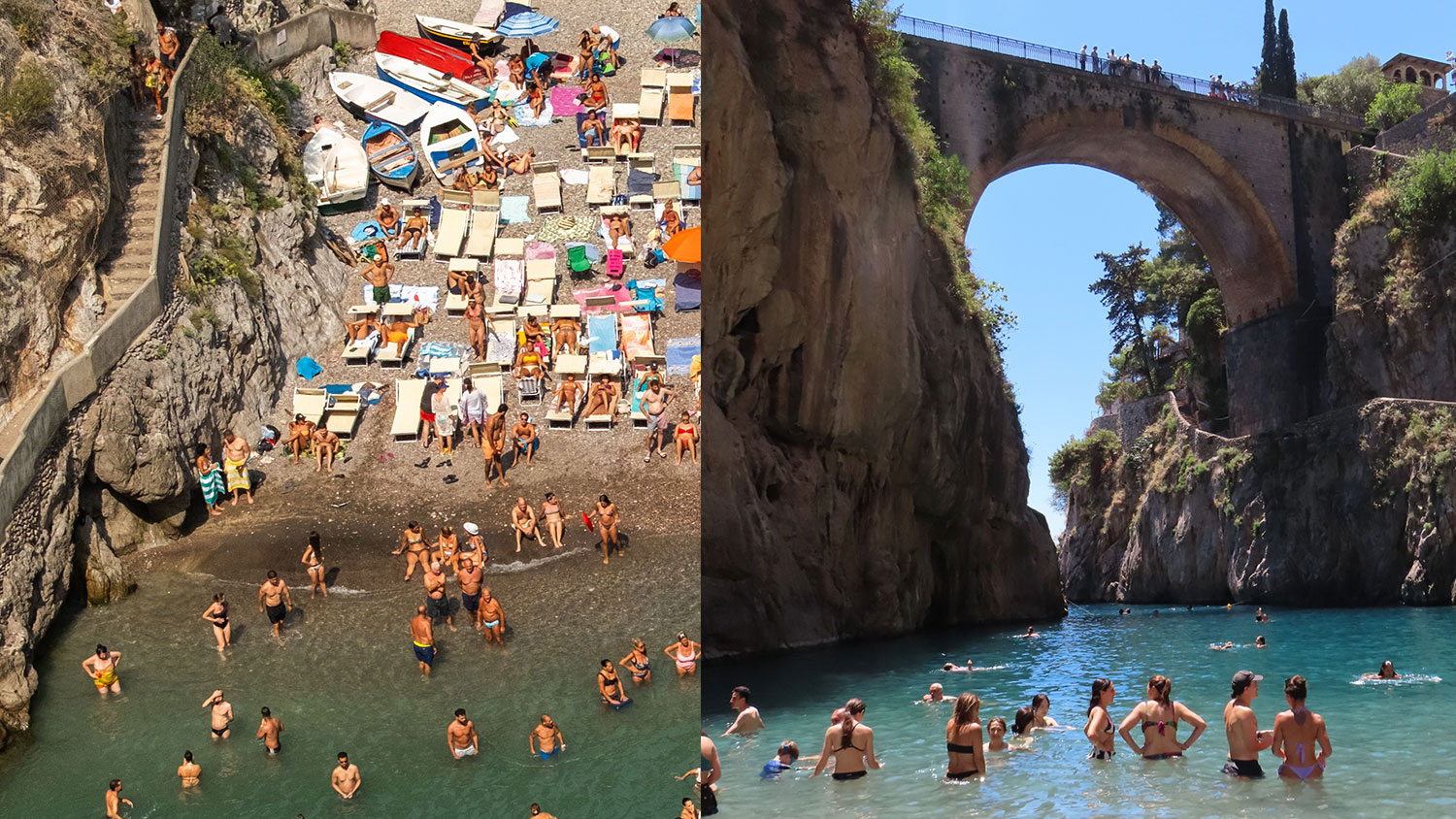
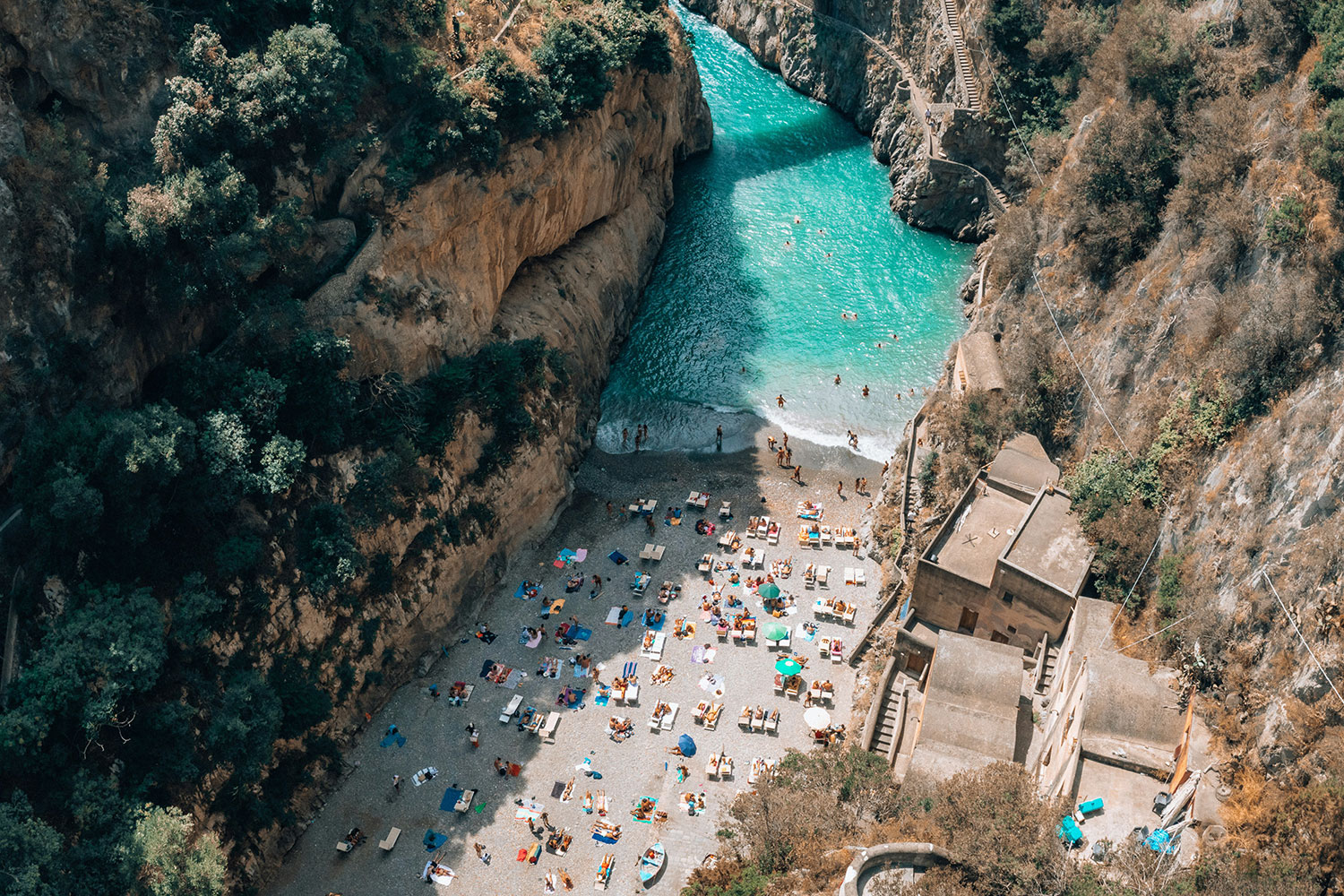
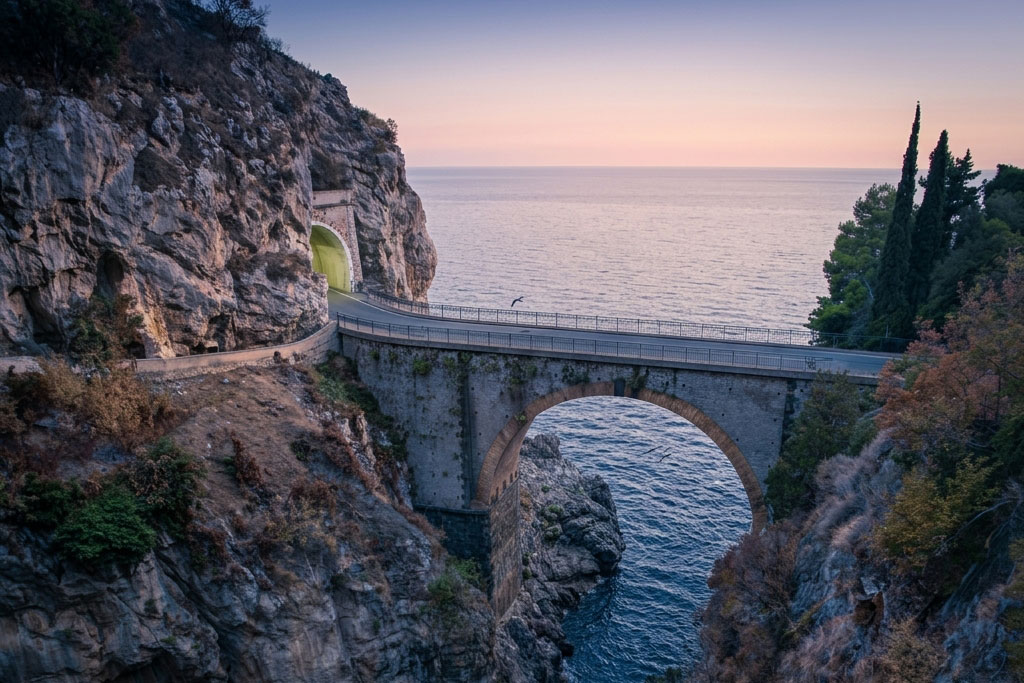
Fiordo di Furore is one of those places that looks slightly unreal in photographs, with a narrow strip of water running between two cliffs, a stone bridge high above it and a tiny pebble beach tucked almost out of sight below the road.
It is also very easy to visit badly.
Parking is scarce, the beach is small, the cliffs block the sun for part of the day, and arriving at the wrong time can leave you wondering where all those peaceful photographs came from.
None of that makes Furore less appealing; it just helps to arrive with the right expectations.
Fiordo di Furore at a glance
A tiny beach beneath one of the Amalfi Coast’s most dramatic bridges — best for swimming, photos and a short stop along the coast.
Is Fiordo di Furore actually a fjord?
Strictly speaking, it is a coastal gorge rather than a true fjord, which would have been carved by glaciers. Furore was shaped by water cutting through the limestone on its way to the sea, although once you are standing below the bridge the geological distinction feels fairly beside the point.
Locally, nobody seems particularly eager to rename it. Furore’s own Pro Loco consistently calls it Il Fiordo, and the gorge is treated as part of the town’s identity and heritage, appearing in local art and forming the centrepiece of the Fiordo Ecomuseum. Geologically, not quite a fjord. Culturally, absolutely the Fiordo.
The cliffs rise sharply on both sides, the road sits surprisingly high above the beach, and the sea narrows into a small channel that feels very different from the open waterfronts of Amalfi, Positano or Maiori.
What is Fiordo di Furore beach actually like?
The first useful thing to know is that the beach really is tiny.
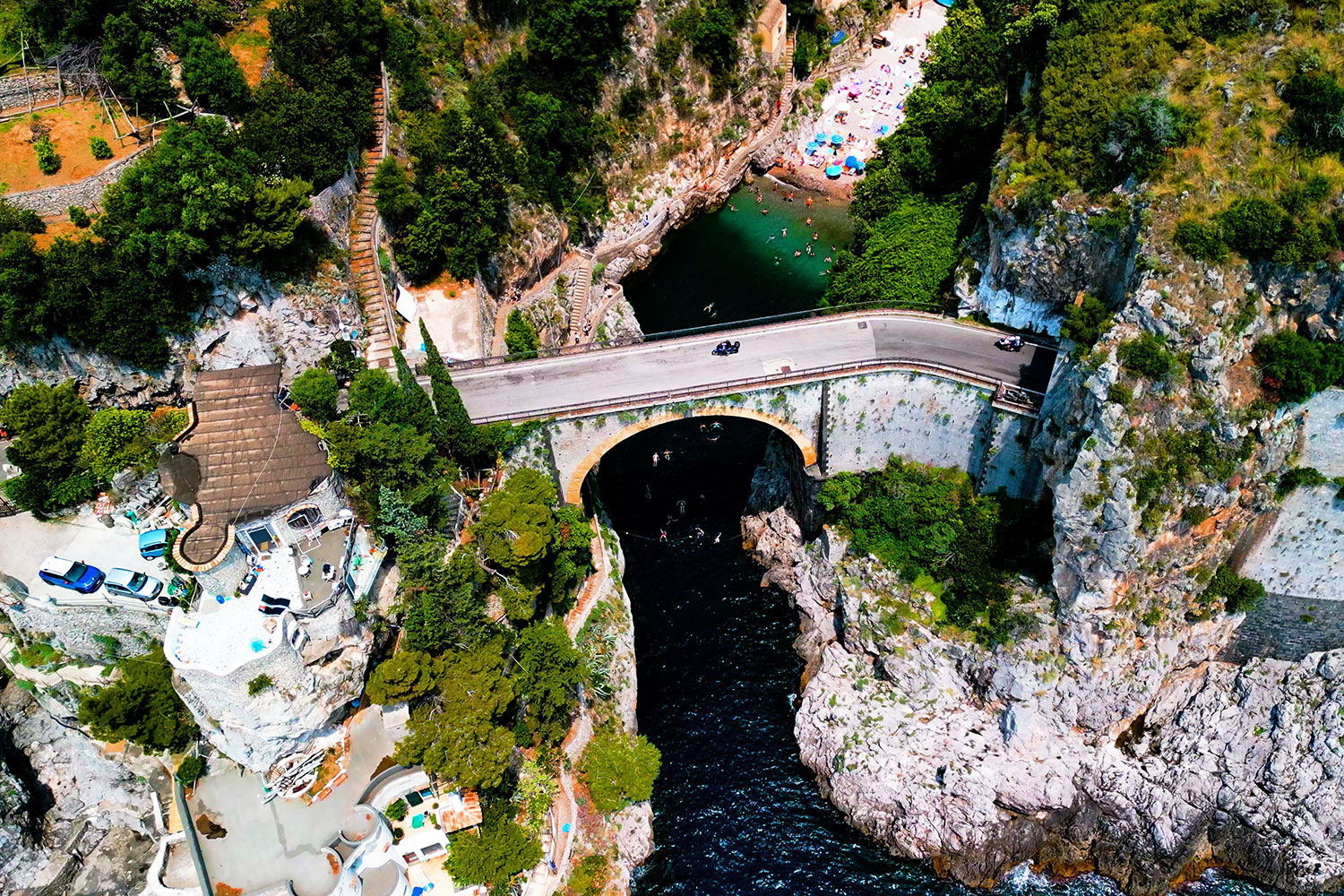
It is a short strip of pebbles at the back of the gorge, so even a fairly modest summer crowd can make it feel busy. By August, the quiet cove you saw in photographs can become a close arrangement of towels, swimmers and people trying to find another patch of beach.
Furore works best as a place to swim and spend a couple of hours, rather than somewhere to settle in for an entire beach day. The appeal is the setting itself: the rock walls, the narrow water and the bridge hanging far above you.
Can you swim at Fiordo di Furore?
Of course, and you definitely should!
On a calm summer day, the water can be beautifully clear, and swimming a little way out from the beach gives you the best sense of how dramatic the gorge really is. From the water, the cliffs feel steeper, the bridge looks even higher, and the whole place becomes much more impressive.
The water gets deep quite quickly, so it is especially enjoyable for confident swimmers.
The cliffs also shape the light throughout the day. Mornings are shadier and often calmer, while late morning and midday bring more direct sun into the gorge.
In July or August, I would still choose the quieter morning. The water is just as inviting, and Furore feels much more special before the beach gets busy.
When is the best time to visit Fiordo di Furore?
Morning is usually the nicest time to come, especially in summer. The beach is calmer, the stairs feel easier before the heat builds and you get more space to enjoy the gorge before the main flow of visitors arrives.
If sunshine matters more than quiet, aim for late morning to midday, when more direct light reaches the beach.
Across the season, May, June and September are probably the sweet spot. The weather is warm, swimming is inviting and the whole coast feels a little easier. July is hotter and busier, while August brings peak-season crowds to a beach that does not have much room to spare.
September is especially lovely: the sea is still warm, the light is softer and Furore usually feels more relaxed.
How do you get to Fiordo di Furore?
Fiordo di Furore sits directly below the SS163 coastal road between Praiano and Conca dei Marini.
The road crosses the gorge on the famous bridge, while stairs lead down towards the old buildings and the beach below.
The walk down is straightforward for most people. The climb back up feels more noticeable after a swim and a couple of hours in the sun, so comfortable shoes or sandals are worth wearing.
👟 The beach sits below the coastal road and is reached by a fairly steep staircase, so expect a noticeable climb back up.
Getting to Fiordo di Furore by bus
For most visitors, the SITA bus is the easiest way to reach the fjord, especially because there is effectively no useful parking beside the beach.
From Amalfi, take SITA line 5070 towards Positano or Sorrento from Piazza Flavio Gioia. Fiordo di Furore sits between Conca dei Marini and Praiano, and the stop is directly on the SS163 beside the gorge. From Positano, take the same line in the opposite direction towards Amalfi. (Sita Sud)
📍 Fiordo di Furore bus stop · Google Maps
How to actually get off at Furore
This is one stop where you should not simply sit back and wait for an announcement.
When you board, tell the driver: “Fiordo di Furore, per favore.” If you are coming from Amalfi, start paying attention after Grotta dello Smeraldo / Conca dei Marini. Furore comes next, before Praiano. Press the stop button as you approach and be ready to get off. SITA treats its stops as request stops, so the bus does not have to stop unless somebody asks.
You step off right beside the gorge and bridge, then continue down the staircase towards the beach. There is no separate bus station or terminal here. It really is a small roadside stop on the coastal road.
Waiting for the bus back
The same request-stop rule matters even more on the return journey.
Stand at the correct stop for your direction, stay somewhere clearly visible to the driver and raise your arm when the bus approaches. Do not assume it will automatically pull over because you are standing nearby.
For Amalfi, wait for a bus showing Amalfi. For Praiano, Positano or Sorrento, wait on the opposite side for a westbound 5070 service.
⚠️ Summer reality: Furore is an intermediate stop, so the bus may already be busy when it reaches you. In July and August, particularly from late morning through the afternoon, buses can become extremely full and a bus with no capacity may be unable to take additional passengers. Give yourself room for the following service rather than making a lunch reservation or ferry connection depend on one exact bus.
How often does the bus run?
There is no dependable “every 30 minutes” rule. SITA changes its timetable by season, day of the week and school/holiday schedule.
On the current September–November 2026 timetable, buses run along the Amalfi–Praiano–Positano route repeatedly throughout the day, but gaps vary considerably between services. Check the current timetable on the day you visit rather than saving an old screenshot.
How much does it cost?
For 2026, the useful fares are straightforward:
Amalfi → Furore: AC1 fare, about €1.80 one way
Positano → Furore: AC2 fare, about €2.60 one way
Several bus trips in one day: the official COSTIERASITA pass is €10 for 24 hours and includes Furore. (Hostel Brikette)
🎟️ Buy your ticket before boarding, either from an authorised SITA/UnicoCampania seller or digitally through UnicoCampania, and validate or activate it correctly when you travel.
The bus sounds slightly chaotic written down, but in practice it is simple: tell the driver you want Furore, watch for the gorge, press the stop button and enjoy one of the most spectacular bus stops on the entire coast.
Getting to Fiordo di Furore by car
Driving to Furore is perfectly possible, but parking is the part that makes it tricky.
There are very few spaces close to the fjord, and the SS163 is narrow and busy through this section of the coast. The bridge is part of the main road, so you cannot treat it as a scenic pull-off or photo stop.
If you already have a rental car, one of the easiest options is to leave it somewhere with proper parking and take the SITA bus for the final stretch. You still get the pleasure of driving the Amalfi Coast without spending part of the day circling Furore looking for a space.
🚗 Driving here is beautiful. Parking beside the fjord usually is not.
Also check the alternating licence-plate restrictions on the SS163 before setting out, as they can apply during busy periods and may affect whether you can drive this section on your chosen day.
Can you visit Fiordo di Furore by boat?
Absolutely, and seeing Furore from the water is one of the smartest ways to experience it.
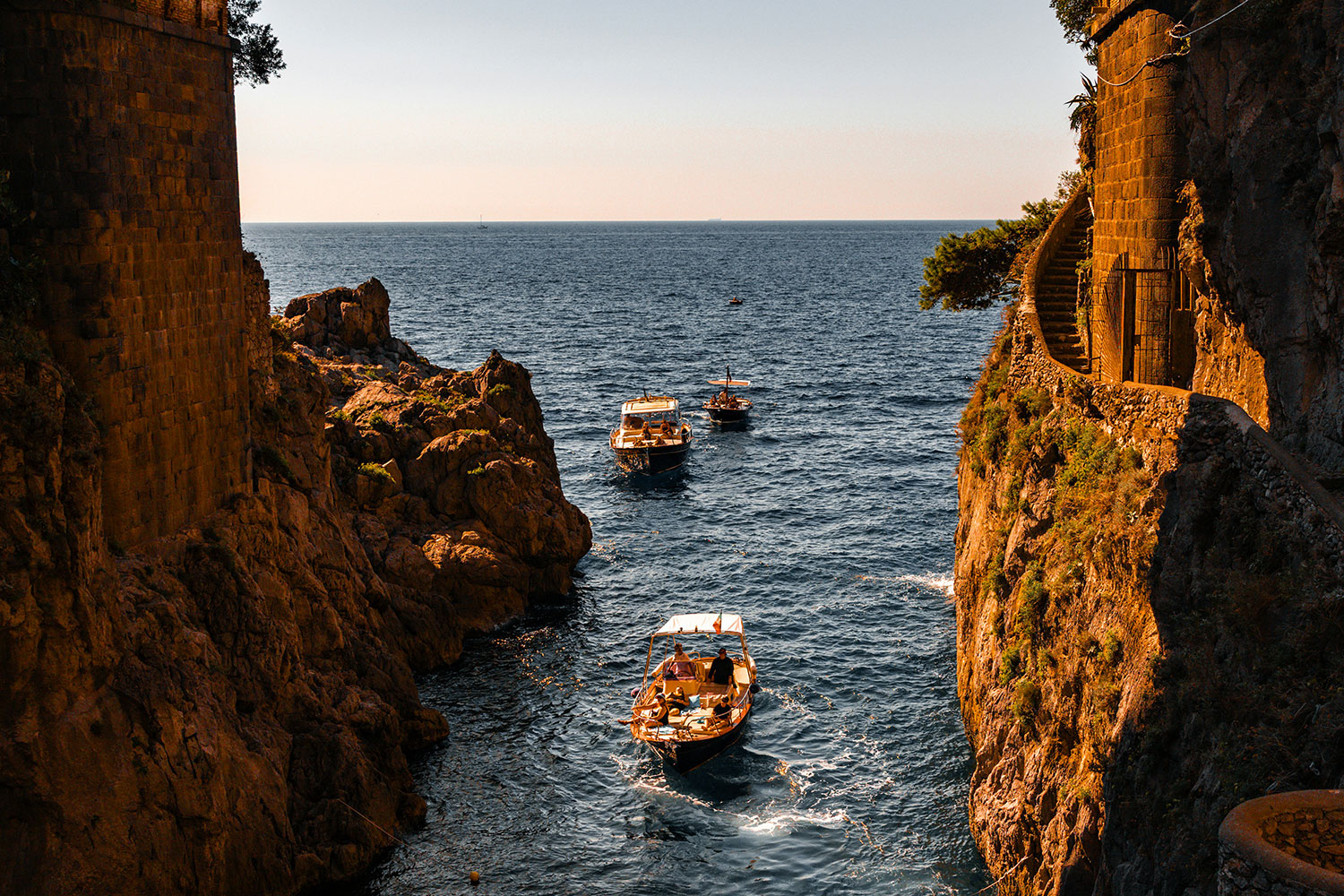
Approaching from the sea gives you a completely different view of the gorge. At first the entrance looks almost impossibly narrow, then the cliffs open around you and the bridge appears high overhead. It is also a very pleasant option if you are already spending a day exploring the coast by private boat.
When conditions allow, skippers can bring you close enough to properly appreciate the inlet. If your boat trip includes a swimming stop, you can usually swim directly from the boat in a safe permitted area nearby. Exactly where the boat can stop depends on sea conditions, other boats and swimmers, and the local navigation rules in force that day. Powered boats must keep clear of areas reserved for bathing, so you should not expect the skipper simply to motor through a busy swimming area or pull up beside the beach.
Fiordo di Furore or other beaches?
Fiordo di Furore is not the beach I would choose for a full lazy day. It is the beach I would choose because there is nowhere else on the Amalfi Coast quite like it.
What makes Furore special is simply the place itself. The beach is tiny, the cliffs rise straight around you, and the bridge sits almost directly overhead. You do not need to stay all day. A couple of hours is usually enough to swim, look around and properly enjoy it.
If you want more space, easier access or somewhere to settle in for lunch and stay all afternoon, beaches such as Marina di Praia, Fornillo or Maiori are better suited to that kind of day.
That is exactly why Furore works so well as part of a wider itinerary. Swim here, take in the gorge, then continue somewhere more relaxed.
Other beaches may be easier, but Furore is the one you’ll remember.
Get the Amalfi Coast map with 300+ places worth knowing.
Beaches, restaurants, viewpoints, parking, transport and useful stops across the coast, all saved in one map.
📥 Offline map · Download once. Use it anywhere.
Free for the first 1,000 users · Sent straight to your inbox.
Why Furore is more than the fjord?
The fjord gets most of the attention, but Furore itself is one of the most unusual villages on the Amalfi Coast.
There is no obvious centre waiting for you at the top. Houses, churches, vineyards and terraces are scattered across the mountainside at different elevations, connected by narrow roads and stairways. That fragmented layout is exactly why Furore became known as “the town that doesn’t exist.”
It also has a strong artistic identity. Across the village, walls are covered with murals, ceramic panels and sculptures inspired by local history, fishing, farming, wine, legends and the fjord itself. They are part of Furore’s long-running “Muri d’Autore” project, which turns the village into something closer to an open-air gallery than a conventional hill town.
And this matters when you visit. A hotel with “Furore” in the address may be only a short distance from the sea on a map, but still sit far above it.
That is part of Furore’s charm. It does not reveal itself all at once. You find it in pieces: the fjord below, vineyards higher up, painted walls, old churches, sea views and houses clinging to the slope.
Before Fiordo di Furore became famous
Long before Fiordo di Furore filled camera rolls, this narrow gorge was a surprisingly busy place to work.
The inlet served as a natural harbour, while the Schiato stream powered mills and small industries through a system of reservoirs, canals and water drops. Local heritage records note that two flour mills, two paper mills and a lime kiln were still operating here into the early 20th century. Paper production was especially important: old cloth was turned into pulp, water powered wooden hammers, and sheets were left to dry beside the gorge. One surviving part of the paper mill still carries the date 1836 carved into the stone. Pro Loco Furore – Ecomuseum of the Fiord
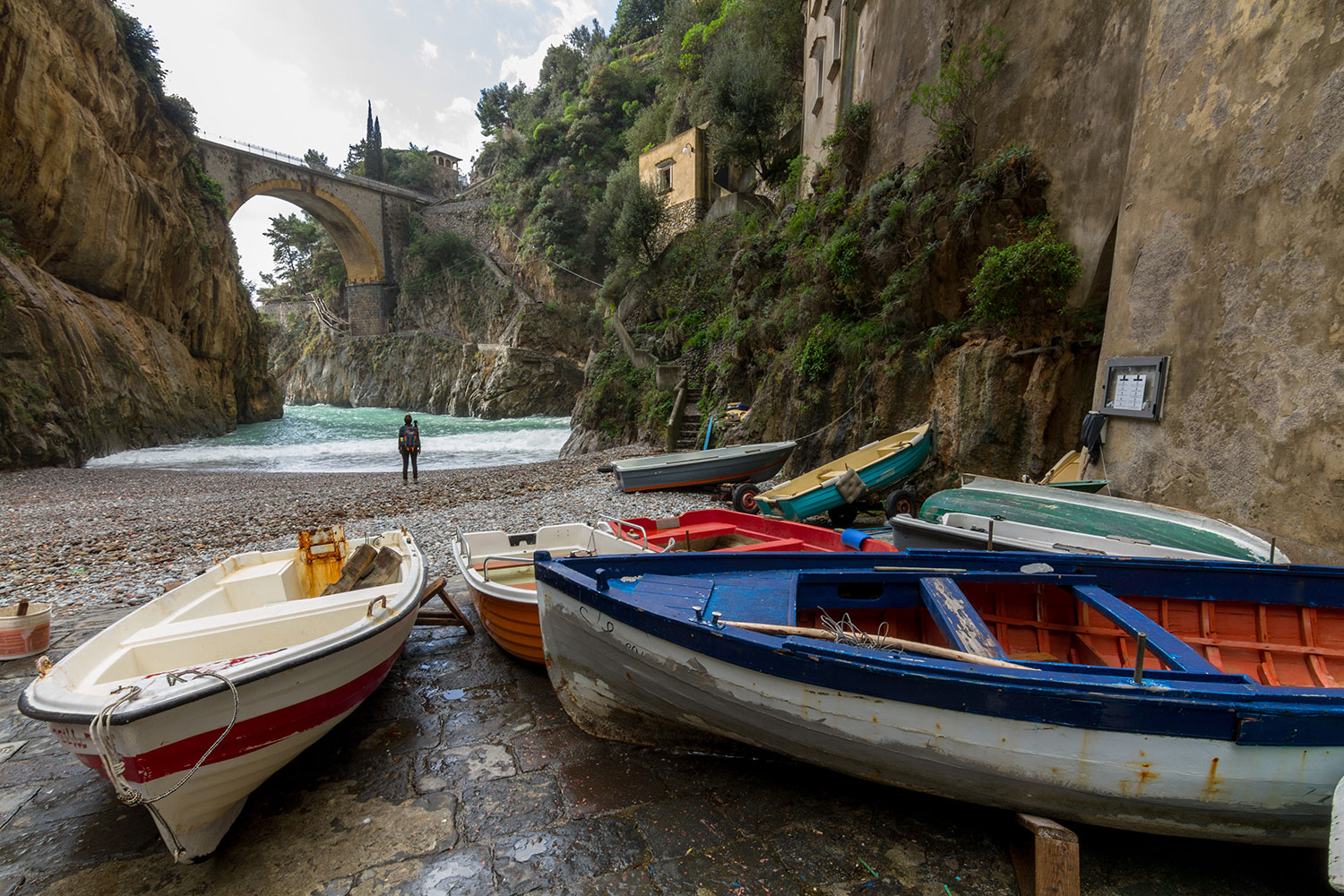
Near the sea stood the fishermen’s settlement known as the monazzeni, a small cluster of houses connected by paths and stairways. Fishing, farming and craftwork shaped everyday life here, making the gorge far more active than its peaceful appearance today suggests.
Even the name has some drama. Furore was historically known as Terra Furoris, traditionally linked to the furious sound of waves crashing into the narrow gorge during storms. The coast, apparently, handled its own branding.
Then cinema arrived. In 1948 Roberto Rossellini filmed parts of Il miracolo here with Anna Magnani and Federico Fellini, adding another chapter to an already unusual place. RAI Cultura – Il miracolo, 1948
Today the machinery is silent, but mills, houses, stairways and industrial remains still survive around the gorge.
Is Fiordo di Furore good for children?
Yes, especially with children who are confident swimmers and comfortable with stairs.
The beach is small and pebbly, the water gets deep fairly quickly, and getting down from the road involves a noticeable staircase. That makes Furore better for a shorter adventure than an easy all-day family beach.
With younger children, Maiori is usually the simpler choice thanks to the wider beach, easier access and more space to settle in.
But for families who enjoy swimming and exploring unusual places, Furore can be a brilliant stop. It feels much more like an adventure than a standard beach day.
How long do you need at Fiordo di Furore?
For most people, one to three hours is about right.
That gives you time to walk down, swim, look around and enjoy the beach without turning a very small place into an all-day plan.
Furore fits especially well into a route between Amalfi, Praiano and Positano, where it becomes one memorable stop among several.
Is Fiordo di Furore worth visiting?
Absolutely. Furore is one of those places that makes the Amalfi Coast feel genuinely special.
The gorge is dramatic, the bridge is far more impressive from below, and swimming between those steep cliffs feels completely different from a normal beach stop. It is small, yes, but that is part of the charm.
The best visit is simple: come earlier in the day, spend an hour or two swimming and taking it all in, then carry on along the coast.
It is not the easiest beach, and it is not the biggest, but it is one of the places you will be very glad you made time for.
Frequently asked questions
Is Fiordo di Furore free?
Yes. Access to the public beach is free.
Can you swim at Fiordo di Furore?
Yes, when access and sea conditions are suitable.
Can you park at Fiordo di Furore?
Parking close to the gorge is extremely limited, so the bus is usually the easier option.
What is the best time to visit Fiordo di Furore?
Morning usually gives you more space, while late morning and midday bring more direct sunlight into the gorge.
Is Fiordo di Furore near Positano?
Yes. It sits east of Positano, between Praiano and Conca dei Marini, along the SS163.
How long should you spend at Fiordo di Furore?
Around one to three hours works well for most visitors.
Is Fiordo di Furore a real fjord?
Geologically, it is a coastal gorge rather than a glacial fjord, although everyone calls it Fiordo di Furore.
Is Fiordo di Furore worth visiting without swimming?
Yes. The bridge and gorge are impressive on their own, although swimming makes the visit more rewarding.
Everything worth knowing before you go, from swimming and stairs to buses, parking and whether it works with children.
Bottom line
Fiordo di Furore is not the easiest beach on the Amalfi Coast, but it is one of the most memorable.
Come for the gorge, the bridge and that first view down to the water. Stay for a swim, take your time on the stairs, and do not worry about trying to turn it into a full beach day. A couple of hours is enough to understand why this tiny place has such a big reputation.
And if Furore fits naturally into your route, go. It is absolutely worth the stop.
I spent 28 years on the Amalfi Coast. I write AmalfiMap to share the beaches, roads, restaurants and small practical details I would tell a friend before they came here. More about Marco →