Amalfi Coast weather has one useful quirk: the air and the sea rarely warm up at the same speed.
May can already feel like summer on land, while the sea is still fairly fresh. September is almost the opposite: the strongest heat starts to ease, but the water stays warm after months of sun.
That difference matters when choosing your dates.
June is one of the easiest months to recommend: long days, little rain and warm enough sea for swimming. July is very reliable for sunshine. August has the warmest water and the strongest heat. September keeps most of the summer feeling, with more comfortable temperatures for walking and exploring. October can still bring beautiful beach days, although the weather becomes more changeable.
Winter is a different Amalfi Coast. Greener hills, quieter towns, more rain and much less beach life. Same coastline, different trip.
I’ve lived with this weather long enough to know that monthly averages only tell part of the story, but they are still useful for comparing seasons.
This guide uses two complementary datasets: a long-term 1995–2024 climate baseline for the charts and month-by-month sections, and more recent 2021–2025 figures for the comparison table and FAQ.
The long-term data shows the usual shape of the Amalfi Coast year, while the recent five-year figures give a closer view of current conditions. Neither should be treated as a forecast for a specific trip, and weather can vary with altitude, exposure and location along the coast.
Best Amalfi Coast weather: August has competition.
Choose the month around the trip you actually want. The weather winner changes the moment swimming, hiking, heat or flexibility becomes the priority.
Amalfi Coast weather month by month: twelve months, four very different trips
Here is the useful version first.
The temperatures are average daily highs and lows for a sea-level Amalfi Coast reference point. Rainfall is monthly average precipitation. Sea temperature is the monthly average around Amalfi. (Italy Frontier)
2021–2025: “Avg high” is the average daily maximum. “Highest” is the highest estimated temperature for that month across those five years.
| Month | Avg high | Highest* | Avg low | Rain | Wet days | Avg sea | Good for |
|---|---|---|---|---|---|---|---|
| January | 13.1°C | 16.9°C | 9.2°C | 166 mm | 15.4 | 16.0°C | Quiet town visits |
| February | 14.0°C | 18.9°C | 9.1°C | 100 mm | 8.0 | 14.9°C | Winter exploring |
| March | 14.9°C | 20.5°C | 10.0°C | 98 mm | 12.0 | 14.9°C | Early spring visits |
| April | 17.1°C | 23.7°C | 11.8°C | 62 mm | 10.8 | 15.9°C | Walking and gardens |
| May | 21.2°C | 28.7°C | 15.7°C | 73 mm | 10.6 | 19.1°C | Hiking and towns |
| June | 26.8°C | 33.8°C | 20.8°C | 25 mm | 3.8 | 23.7°C | Best overall balance |
| July | 29.7°C | 34.0°C | 23.8°C | 9 mm | 2.0 | 26.8°C | Dry beach days |
| August | 29.4°C | 33.5°C | 23.8°C | 33 mm | 6.6 | 27.1°C | Warm-water swimming |
| September | 25.9°C | 31.0°C | 20.7°C | 125 mm | 8.2 | 25.3°C | Swimming and exploring |
| October | 22.1°C | 26.9°C | 17.4°C | 99 mm | 9.6 | 22.5°C | Walks and autumn dips |
| November | 17.8°C | 23.9°C | 13.9°C | 244 mm | 16.2 | 20.3°C | Food and town visits |
| December | 14.9°C | 19.7°C | 10.9°C | 146 mm | 11.6 | 17.8°C | Christmas and local life |
*Highest means the peak in this model dataset during 2021–2025, not an all-time weather-station record. Local temperatures can differ, and the model can smooth out extremes. Air: ERA5-Land estimates adjusted to sea level for the Amalfi location. Rain: ERA5 regional estimates. Calculations use Open-Meteo historical data. Wet days average at least 1 mm of precipitation per day.
Sea: calculated from SeaTemperature.info’s published 2021–2025 monthly averages: Jan, Feb, Mar, Apr, May, Jun, Jul, Aug, Sep, Oct, Nov, Dec. Five-year averages describe recent conditions; they are not a forecast for your trip.
Amalfi Coast climate charts: the entire year in about 30 seconds
Numbers become much easier once you stop making your brain behave like Excel.
The coast has three very obvious weather seasons: a wetter, mild winter; an increasingly warm spring; then a remarkably dry summer followed by a fast return of autumn rain. November averages around 191 mm of rain versus just 15 mm in July in the ERA5 shoreline series. (Italy Frontier)
The forecast expires. This one stays useful.
Get our one-page Amalfi Coast weather card: every month, sea temperature, rain pattern and the kind of trip each month actually suits.
Amalfi Coast weather in January: the coast turns the volume down
January is mild in the Mediterranean sense: around 12.5°C during the day and 8.5°C at night on the shoreline average.
This version of the Amalfi Coast revolves around villages, food, clear views and local life. Rain arrives much more regularly than in summer, while the steep mountains turn a sunny winter day into something surprisingly crisp and photogenic.
Sea temperature sits around 14.8°C, so January swimming belongs to people who say things like “it’s actually quite refreshing” while everybody else remains fully dressed.
The stronger reason to come is space. Amalfi, Vietri, Maiori and the more lived-in towns retain everyday life, and winter light can make the coastline look almost surgically sharp.
Amalfi Coast weather in February: spring starts rehearsing
February stays close to January at around 12.9°C by day, while rainfall begins easing.
You gain a little more daylight, gardens begin moving towards spring and calm sunny afternoons can feel remarkably pleasant in sheltered places.
The sea reaches its coldest annual point around February, averaging roughly 13.8°C. Beach towels can remain comfortably in the suitcase.
For a winter road trip or a quiet stay built around villages and restaurants, February has its own logic. For a beach-first trip, later months offer a much richer menu.
Amalfi Coast weather in March: the first T-shirt afternoon can appear surprisingly early
March averages around 14.6°C by day and 9.5°C at night.
The useful thing about March is range. A sheltered terrace in full sun can feel considerably warmer than the headline number; a cloudy mountain morning can remind you that spring has only recently clocked in.
The landscape starts waking up properly. Walking becomes more inviting, daylight stretches farther and the coast gradually prepares for the main season.
The sea remains around 13.8°C, so March is a land-based month: towns, viewpoints, gardens, food and walks.
Amalfi Coast weather in April: walking weather starts getting seriously good
April reaches an average high of about 17.3°C and rainfall drops to roughly 79 mm.
For exploring, that is a very useful combination.
You can spend several hours outside without designing your life around shade. Ravello feels made for walking. The Path of the Gods becomes much more comfortable. Amalfi and Positano can be explored properly rather than converted into a sequence of strategic air-conditioning stops.
The sea averages around 15.3°C, making April swimming a specialist hobby.
The main visitor season also begins taking shape during spring, including the return of many seasonal ferry connections. Exact operating dates change by route and operator each year.
Amalfi Coast weather in May: summer starts before the sea gets the memo
May is one of the smartest months on the calendar.
Average highs reach about 21.2°C, rainfall falls to around 65 mm, the mountains remain green and full summer heat is still waiting offstage.
This is excellent weather for travellers who want to do several things in the same day: hike in the morning, explore a town, sit outside for lunch and end beside the sea.
The only little trick is water temperature.
The Mediterranean averages around 18.7°C in May. Plenty of people swim happily; plenty of others enter up to the knees and immediately discover a sudden interest in photography.
For active trips, May is outstanding.
Amalfi Coast weather in June: Goldilocks finally books a hotel
June is the month where almost every part of the trip starts agreeing with every other part.
Average highs sit around 25.3°C. Rainfall falls to only 30 mm. The sea reaches roughly 22.7°C. Days are long.
You can swim properly, hike with a sensible start time, take ferries, have dinner outside and wander after sunset while the evening still feels warm.
For pure weather versatility, June is our strongest all-round choice.
July gives you slightly greater weather certainty. August gives you warmer water. September has its beautiful late-summer balance.
June simply makes very few demands in return.
Amalfi Coast weather in July: reliable sun, serious stairs
July is the driest month in the 30-year ERA5 series used here, with around 15 mm of rain across the whole month and an average high of 28.1°C. (Italy Frontier)
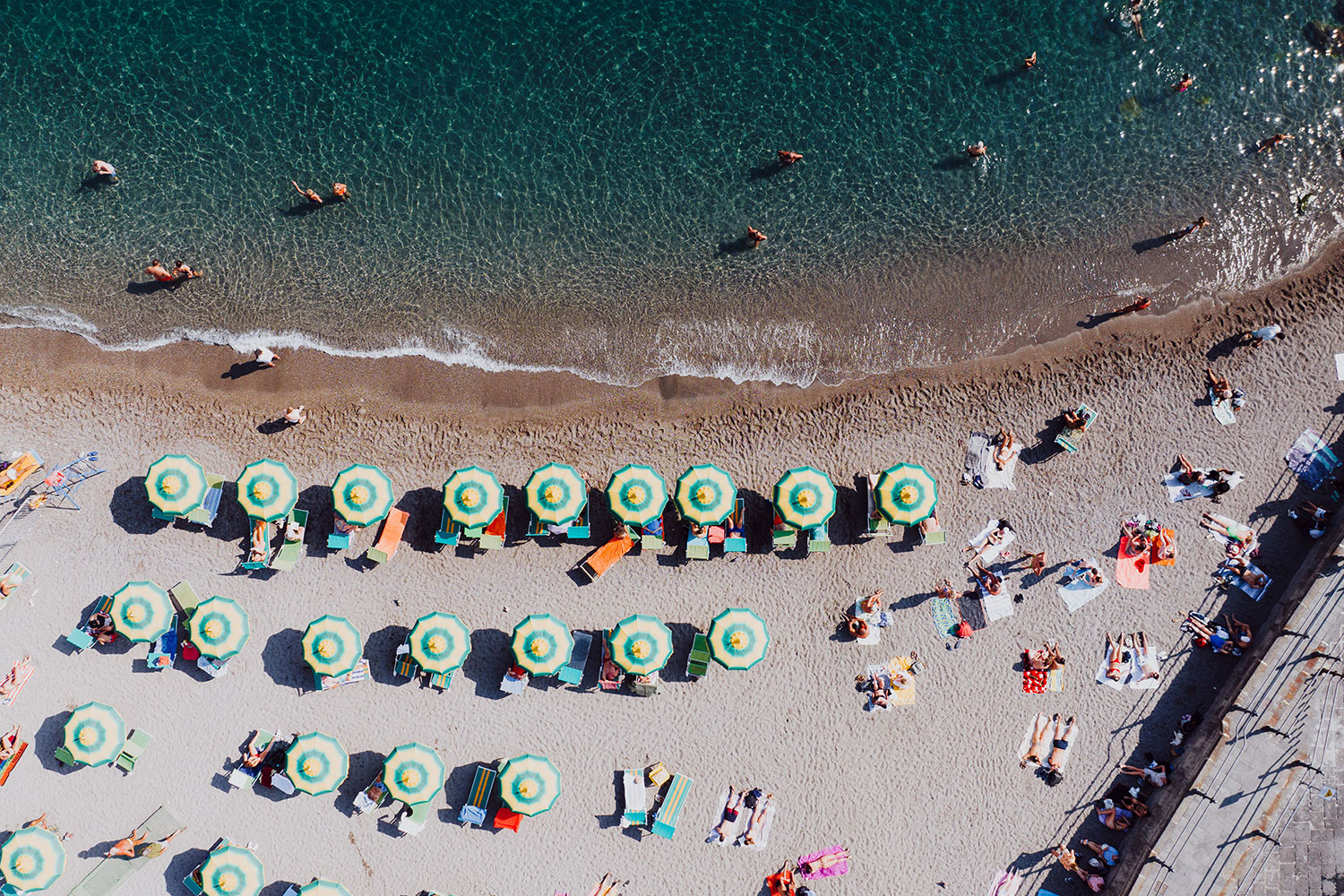
For most trips, that makes July wonderfully easy to plan around. Beach days, boat trips and dinners outside all fit naturally into the month, and long stretches of settled weather are common.
The heat feels a little different once you add the Amalfi Coast itself. Positano, Praiano, Furore and many hillside stays come with steep streets, long staircases and plenty of direct sun, so 28°C can feel much warmer halfway up to your room. In July, I like to use the morning for walking and exploring, keep the middle of the day for the sea, lunch or shade, then head out again later in the afternoon.
Amalfi Coast weather in August: the Mediterranean reaches full volume
August is the hottest month in the dataset, averaging around 28.6°C by day and 22.9°C at night. The sea reaches approximately 26°C. (Italy Frontier)
For a swimming-first holiday, those are excellent numbers.
The water is properly warm, the evenings stay easy, and packing is simple: light summer clothes, swimwear and something thin for later.
Bear in mind that August is also the busiest part of summer, especially around Ferragosto and the main Italian holiday period. The weather is usually the easy part; transport, beach space and timing deserve a little more planning.
Starting earlier in the day helps a lot. Beaches are easier, ferries feel less hectic, and by the time the coast gets properly busy, you can already be somewhere with a towel and a cold drink.
Amalfi Coast weather in September: summer develops better manners
September is a good choice if you want warm weather and a sea that still feels like summer, with more comfortable temperatures for exploring.
Average daytime temperatures are around 24.9°C, while the sea stays warm at 24.2°C. Evenings are milder, walking is more pleasant, and you can still enjoy meals outside.
Rainfall increases to around 100 mm, so there is a greater chance of showers than in July or August. Leave some flexibility in your plans, especially for beach days and boat trips.
Early September usually feels like summer. Towards the end of the month, the weather becomes more changeable, but the sea often remains warm enough for swimming.
Amalfi Coast weather in October: still swim, give the weather a vote
October brings average daytime temperatures of 21.4°C, with the sea still around 21.8°C. Sunny days can be warm enough for swimming and lunch outside, while cooler temperatures make walking and sightseeing more comfortable.
Rainfall averages around 124 mm, so it helps to keep your plans flexible. Choose clear, calm days for boat trips, Capri or the beach, and dry days for longer hikes. Cloudier days suit exploring Amalfi, visiting Vietri’s ceramics shops or settling into a long lunch.
October is a good month to let the weather decide the order of your plans.
Amalfi Coast weather in November: the hills go green and the rain gets ambitious
November is the wettest month on the coast, averaging around 191 mm of precipitation across roughly 14 wet days.
Average daytime temperature remains a relatively mild 17.3°C, so cold itself rarely defines the experience.
Water does.
The Lattari Mountains rise abruptly behind the coastline. Moist Mediterranean air meets that topography, rises, cools and produces considerably more autumn and winter rain than the summer postcard might suggest.
The result is a coast that turns greener, quieter and more weather-led.
For slow travel, food, lived-in towns and dramatic skies, November can be surprisingly atmospheric. For a four-day beach-and-boat itinerary, summer offers the cleaner equation.
Amalfi Coast weather in December: winter, translated into Italian
December averages around 13.8°C during the day and 9.9°C overnight, with roughly 156 mm of rainfall. Winter arrives, but usually leaves the snow shovel at home.
Christmas lights brighten the towns, the mountains turn green, and sunny breaks can still be warm enough for coffee outside. A seat in the sun becomes prime real estate.
The sea averages 16.8°C. Swimming is possible, though most people prefer to admire that particular number fully dressed.
Seasonal hotels and restaurants take a break, while Amalfi, Vietri and Maiori keep their everyday rhythm. You’ll find Christmas preparations, local cafés and people buying groceries—December is mostly unconcerned with your itinerary.
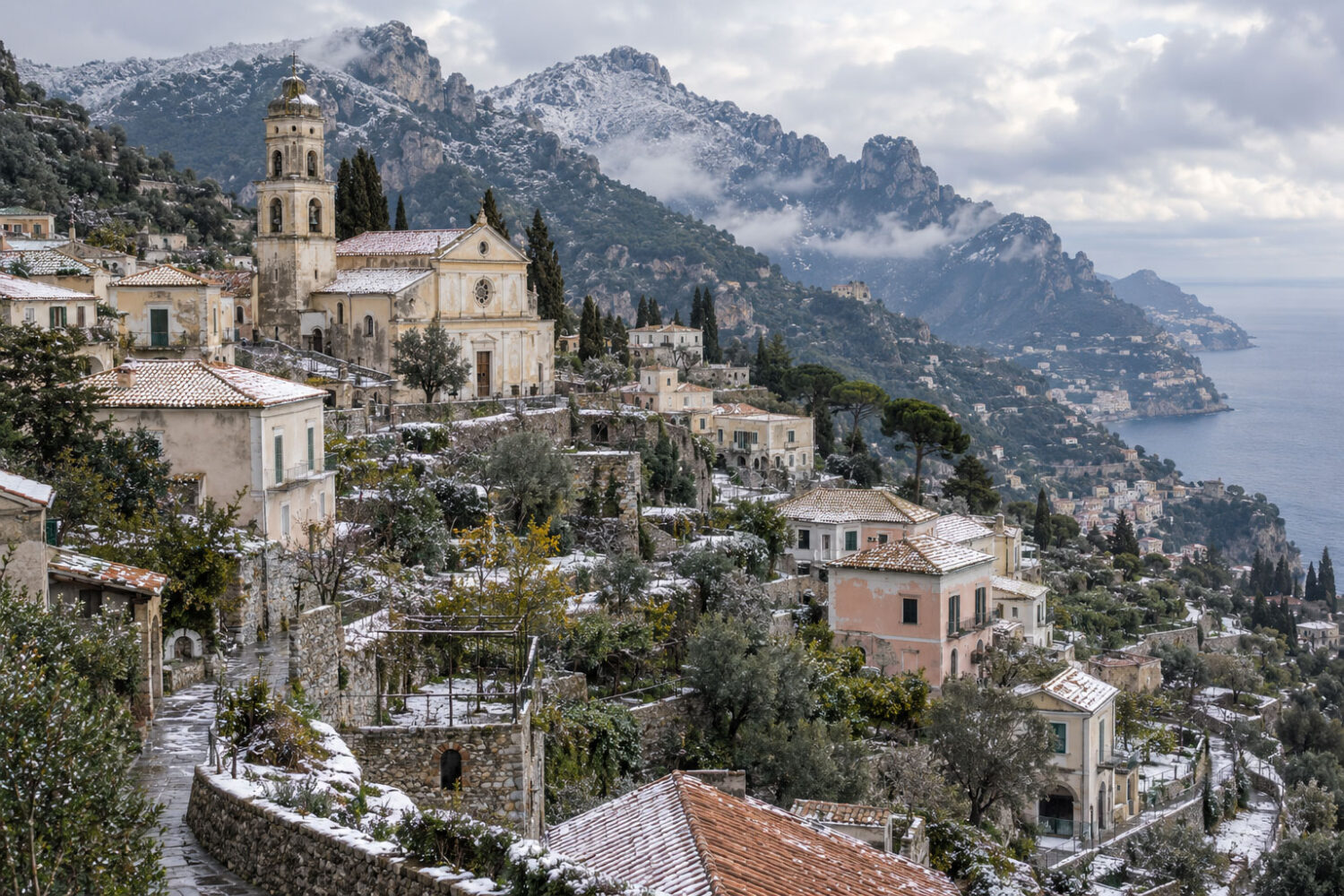
Amalfi Coast snow: yes, it happens and it once supplied summer sorbet
The Amalfi Coast gets snow, mainly in its mountains and higher villages. During winter cold snaps, places such as Agerola, Tramonti and Scala can see snowfall while towns beside the sea get rain. A snowy mountain above a sunny waterfront is entirely possible here. Snow on the shoreline is much rarer.
The mountains once provided something valuable for the warmer months, too. According to Corriere della Sera, snow collected around Monte San Michele, high above Positano, was preserved in caves and ghiacciaie, or ice stores, so it could last into summer. Medieval Amalfi merchants used that stored cold to make lemon sorbets.
Winter did the freezing; summer got dessert. Before electric refrigeration, keeping snow frozen for months took planning—and made a bowl of lemon sorbet considerably more of an achievement.
For a winter visit, elevation matters. A mild afternoon by the harbour can come with much colder conditions in the villages above, so check the forecast for the actual town or walking route you plan to visit.
Amalfi Coast rain: when it falls and why it can be so heavy
Rain on the Amalfi Coast is concentrated in autumn and winter. July and August are usually the driest months, with long sunny stretches. Showers become more frequent through September and October, while late autumn and winter bring longer wet spells between brighter days.
The sea and mountains help explain the heavier downpours. Moist air arriving from the Mediterranean meets the steep Lattari Mountains and is pushed upwards. As it rises, it cools, allowing clouds and rain to develop. In autumn, the sea still holds summer warmth, supplying moisture that can feed intense showers and thunderstorms when cooler weather arrives.
A rainy month does not mean rain every day. Several heavy downpours can account for a large share of the monthly total. That is why autumn can bring both warm afternoons by the sea and thoroughly wet days—and why rainfall figures alone tell you less than you might expect about a week’s holiday.
Amalfi Coast sea temperature: September is warmer than May
The sea warms more slowly than the air and holds its heat longer. That is why a warm day in May can come with a rather brisk first swim, while September’s water still feels like summer.
Average sea temperatures rise from 18.7°C in May to 22.7°C in June, then exceed 25°C in July and peak around 26°C in August. September stays warm at 24.2°C, while October averages 21.8°C. (Climate Data)
June through September is the most reliable period for comfortable swimming. May suits people happy with cooler water, particularly for shorter dips. October can still offer pleasant swimming on sunny, calm days, although cooler air makes getting out feel noticeably different.
If swimming is a priority and you are choosing between spring and early autumn, September offers considerably warmer water than May. Both can bring lovely beach weather, but the sea has had an entire summer to warm up by September.
Best time to visit the Amalfi Coast: decide what “best” is buying you
Weather rankings become much more useful once they have a job.
Amalfi Coast summer heat: plan for the stairs, too
August’s average daytime high of 28.6°C describes typical conditions, rather than the hottest days you might experience. Walking uphill through Positano, climbing steps to your accommodation or waiting at a sunny ferry pier can feel much hotter than the forecast suggests.
The amount of climbing matters when choosing where to stay. A room with a panoramic view may come with several hundred steps, so check the walking route from the beach or ferry terminal as well as the distance. A short walk on the map can be a sweaty one in practice.
Plan longer walks and sightseeing for the morning, then leave the hottest hours for a shaded lunch, a rest or time by the water with access to shade. Carry water, refill whenever you can and save another walk for when the heat eases towards evening.
Is the Amalfi Coast humid? Yes, although the sea breeze usually joins the conversation
The humidity can take some getting used to, especially if you come from a drier climate. In summer, your shirt can stick to your back after a short walk, and the steps to your accommodation suddenly feel like proper exercise. Give yourself time to adjust—and a fresh shirt for dinner.
One long-term dataset puts average humidity at around 70–76% throughout the year. How it feels depends on the temperature and airflow: pleasant beside the water with a breeze, much heavier in a sheltered lane on a hot afternoon.
Air conditioning makes summer nights more comfortable, so check before booking. Bring loose, breathable clothes, carry water and take the climbs slowly. There is usually a good reason to stop and admire the view anyway.
Ravello weather vs Positano: the beach and the hilltop can need different clothes
Ravello is a hilltop town around 350 metres above the sea, known for its villa gardens, concert terraces and coastal views. Positano is the colourful seaside town built up steep slopes from the beach, with its ferry pier and waterfront at sea level. Your altitude in Positano depends on how far uphill you are staying.
That difference in elevation helps explain why Ravello can feel cooler than Positano’s waterfront, particularly in the evening. On a warm summer day, the fresher air can be welcome. In spring and autumn, a light layer is useful if you plan to stay for dinner.
Cloud cover can differ, too. Low cloud may gather around the hills while the waterfront below stays brighter. Equally, sunshine in Ravello can feel warm even when the air is cooler—elevation is only part of the picture, alongside wind, shade and cloud.
Check the forecast for the town you are visiting, especially when moving between the beach and the hills. A single “Amalfi Coast” forecast covers too much varied terrain to tell you what to wear everywhere.
Amalfi Coast ferry weather: wind matters more than the rain icon
Ferries can run in rain and be cancelled in sunshine. What matters is whether wind, waves and conditions at the departure and arrival ports allow the journey to operate safely.
When checking the forecast, look at wind and sea conditions, then check your ferry operator’s service updates before heading to the pier. A standard weather app’s rain symbol tells you little about the crossing.
If a coastal ferry is cancelled, buses, taxis and private transfers provide alternatives between mainland towns, though the journey can take longer. Capri has no road connection, so allow extra time when an island visit comes before a flight or train journey.
Keep your essential connections comfortably ahead of the last available sailing. A cancelled afternoon boat is easier to manage when you still have time and options.
300+ places. One map. Made by locals.
Your Amalfi Coast map.
Ready to explore offline.
300+ personally checked beaches, restaurants, viewpoints and useful stops, ready for the days around Ravello.
Download once. Explore whenever you want.
Free only for the first 1,000 users
Amalfi Coast weather forecast: give the next 72 hours the important jobs
A ten-day forecast is useful for seeing a broad weather pattern.
It becomes much less interesting when it claims to know exactly which hour next Thursday will contain a shower.
For actual itinerary decisions, I start taking the forecast seriously inside roughly 48–72 hours, then check again the evening before any weather-sensitive plan.
For a boat day, add a marine forecast.
For the Path of the Gods, check rain, wind, cloud and visibility around the higher terrain.
For an ordinary town day, the threshold can be wonderfully relaxed. Amalfi remains Amalfi under a cloud.
This is especially useful in October and spring: plan the ingredients, then let the forecast choose their order.
Amalfi Coast packing by month: bring shoes you trust and a spare shirt
June–September: pack loose, breathable clothes, swimwear, sunglasses, sunscreen and a hat that stays on in a breeze. Bring a spare top for sweaty afternoons and a light shirt for the ferry. Two swimsuits are useful: one to wear while the other dries.
May: bring the summer basics, plus a jumper or light jacket for dinner outside. You may spend the afternoon in swimwear and want another layer by the time you order dessert.
April and October: pack T-shirts, long trousers, a warmer layer and a lightweight waterproof jacket. Keep swimwear in the bag if you enjoy cooler water. A small umbrella is useful in town; a hooded jacket is easier on windy days when you need a hand for the railings.
November–March: bring a warm jacket, layers and water-resistant shoes with grip. Ask your accommodation about heating, particularly in older buildings. Slippers and warm socks take little room and make cool tiled floors much more pleasant.
Whatever the month, bring walking shoes you have already worn comfortably. Save flip-flops for the beach. Water shoes are useful on pebbly beaches, and a small zipped day bag keeps your hands free on stairs and boats.
Pack a refillable water bottle, any medicines you need and a compact power bank for long days using maps and tickets. And before choosing your suitcase, ask how many steps lead to your accommodation. Pack something you can carry up them yourself.
Warm jacket, jumpers, rain protection and water-resistant shoes with grip.
Pack warm socks for cool tiled floors.
T-shirts, long trousers, a jumper, a light waterproof jacket and walking shoes.
Bring a layer for dinner outside—even after a warm afternoon.
Breathable clothes, two swimsuits, a hat, sunglasses, sunscreen and comfortable walking shoes.
A fresh shirt for dinner earns its space in your bag.
Light and warm layers, a waterproof jacket and shoes with grip. Add swimwear for October.
A hooded jacket leaves your hands free for bags and railings.
Amalfi Coast weather FAQ: what to know before you book
Figures below cover 2021–2025. Air temperatures and rainfall are calculated from ECMWF ERA5-Land/ERA5 data accessed through Open-Meteo, with temperatures adjusted to sea level. They are model estimates, rather than local weather-station records. Sea temperatures use the annual monthly averages published by SeaTemperature.info for the same five years. Air and rainfall methodology
What is the best month for Amalfi Coast weather?
June is a strong all-round choice, with average daily highs around 27°C, approximately 25 mm of monthly rain and sea temperatures around 24°C in the recent five-year data. September offers warmer water, with more rainfall.
What is the hottest month on the Amalfi Coast?
July and August are closely matched. Over 2021–2025, average daily highs were 29.7°C in July and 29.4°C in August, with average daily lows around 24°C.
The highest temperature in the model series was 34°C on 25 July 2025. August’s highest was 33.5°C on 11 August 2024. These estimates can smooth out local extremes; they are not the coast’s all-time temperature records. Dataset methodology
What is the coldest month?
January had the lowest average daily high, around 13°C, followed by February at 14°C. Average daily lows were approximately 9°C in both months.
The lowest temperature in the 2021–2025 model series was 1.2°C on 14 February 2021. January’s lowest was 3.8°C on 25 January 2022. These figures represent estimated shoreline conditions; higher villages can be colder. Dataset methodology
What is the wettest month?
November, averaging approximately 244 mm of rain over 2021–2025 in the regional model data. Heavy downpours can account for a substantial share of that total, with brighter days between wet spells.
What is the driest month?
July, averaging approximately 9 mm of rain over 2021–2025. Long dry stretches are typical, although occasional showers and thunderstorms remain possible.
Can you swim on the Amalfi Coast in May?
Yes, although the water can feel brisk. May’s sea temperature averaged around 19°C over 2021–2025, with individual monthly averages ranging from 18.7°C to 19.6°C. It suits shorter dips and swimmers comfortable with cooler water. Source
Can you swim in June?
June is a good swimming month for many travellers. The sea averaged around 24°C over 2021–2025, with individual June averages between 23.2°C and 24.6°C. Early June can feel noticeably fresher than the end of the month. Source
Can you swim in September?
September is one of the best choices for warm-water swimming. Sea temperatures averaged 25.3°C over 2021–2025, with individual September averages ranging from 24.9°C to 25.8°C. The water retains summer warmth as the evenings begin to cool. Source
Can you swim in October?
Yes, particularly on sunny, calm days. October’s sea temperature averaged around 22.5°C over 2021–2025, with individual monthly averages ranging from 21.7°C to 23.7°C. Bring a warm layer for afterwards: getting out can feel cooler than getting in. Source
Is September rainy on the Amalfi Coast?
September averaged approximately 125 mm of rain over 2021–2025, alongside average daily highs around 26°C. Warm beach days remain part of the month, but allow room to rearrange outdoor plans around wet spells.
Is October rainy?
October averaged approximately 99 mm of rain over 2021–2025, with average daily highs around 22°C. It was drier than September in this particular period. A five-year sample can be strongly influenced by individual storms and unusually dry months.
Does it rain all day?
Sometimes, particularly when an autumn or winter weather system settles over the coast. Other days bring a short downpour followed by brighter skies. Check the hourly forecast to see whether rain is expected briefly or through much of the day.
Is the Amalfi Coast humid in summer?
Yes, and it can feel intense if you come from a dry climate. NASA POWER estimates for the area put June–August average relative humidity at roughly 69–74% over 2021–2025. A sea breeze helps; sheltered lanes and uphill walks can feel much heavier. NASA POWER methodology
Does it snow on the Amalfi Coast?
Occasionally, mainly in the mountains and higher villages. Agerola, Tramonti and the hills above Positano are more likely to see snow during winter cold spells. Snow beside the sea is much rarer.
Is Ravello colder than Amalfi?
Ravello generally feels cooler because it sits around 350 metres above sea level, while Amalfi’s waterfront is at the shore. Bring a light layer if you are heading up for dinner, particularly in spring or autumn.
Is the Path of the Gods cooler than Positano?
It can be, especially around the higher starting point in Bomerano and early in the morning. The exposed trail can still feel hot in direct sun. Check the forecast for the higher terrain and carry enough water.
Which months are best for the Path of the Gods?
May, early June, September and early October offer a useful balance of daylight and walking temperatures. Choose a dry day with good visibility, and check for heat, wind or storm warnings before setting out.
Which months are best for beach weather?
July and August offer the most dependable combination of heat, warm water and dry weather. September is particularly appealing if warm swimming matters more to you than having the lowest chance of rain.
Is August unbearably hot?
August can feel demanding, especially if your day involves plenty of climbing. Humidity, direct sun and warm nights all contribute. Explore early, take a proper midday break and choose accommodation with air conditioning.
The forecast for your dates matters more than a monthly average when deciding how much walking to fit into a day.
Can bad weather cancel ferries?
Yes. Strong winds and rough seas can delay or cancel sailings. Check your operator’s updates before going to the pier, especially when your ferry connects with a train or flight.
Can ferries run in rain?
Yes. Wind, waves and conditions at the ports matter more than rainfall alone. A rainy crossing may operate normally, while strong wind on a sunny day can disrupt services.
Are thunderstorms common?
Summer is generally dry, although thunderstorms can occur. They become more of a consideration as the weather turns unsettled in autumn. Check local warnings before exposed walks or boat trips.
Which month has the clearest views?
There is no reliable monthly winner. Clear air after a weather system passes can bring excellent views, while summer sometimes brings haze. Cloud height and visibility on the day matter more than the month.
Is the Amalfi Coast windy?
Conditions range from calm days to strong winds that affect boats and exposed paths. Check wind speeds and gusts for your destination, particularly before ferry travel or a mountain walk.
How far ahead should I trust the forecast?
Use longer forecasts for the broad pattern. Make firmer decisions about beaches, boats and hikes within 48–72 hours, then check again the evening before and on the day.
What weather app should I use?
Choose one that shows hourly rain, wind and gusts for individual towns. Add a marine forecast for days at sea and check ferry operators’ service updates. A single forecast labelled “Amalfi Coast” can miss the differences between the waterfront and the hills.
Made by amalfimap.com
300+ places.
One free Amalfi Coast map.
Beaches, places to eat and stops worth making. All saved in one map on your phone.
Download once. Explore offline.
Free download · Sent to your inbox
Amalfi Coast weather: choose your month.
Beach days, cooler walks or warm autumn swims—start with what matters most to your trip.
| Your priority | When to go | What to expect |
|---|---|---|
| Best overall balance | June | Average daily highs around 27°C, sea around 24°C and long days for exploring. |
| Beach weather | July–August | Average daily highs around 30°C, warm water and mostly dry weather. Plan for hotter spells. |
| Warm autumn swimming | September | Sea temperatures averaging 25.3°C, with average daily highs around 26°C. |
| Walking and sightseeing | May or October | Average daily highs around 21–22°C. Choose dry days for the trails. |
| Lowest rainfall | July | Approximately 9 mm of monthly rainfall in the 2021–2025 regional estimate. |
| Wettest month | November | Approximately 244 mm of monthly rainfall in the same five-year estimate. |
| May swimming | Cooler dips | Sea averaging around 19°C. A good fit if you enjoy fresher water. |
| October swimming | Still possible | Sea averaging around 22.5°C. Sunny, calm days are especially appealing. |
| Winter exploring | December–February | Average daily highs around 13–15°C at sea level. Bring layers and rain protection. |
| Boats and longer hikes | Check 48–72h ahead | Look at wind, rain and visibility. Check sea conditions and operator updates for boat trips. |
| Our pick | June or September | June for lower rainfall and long days. September for warmer swimming. |
Figures cover 2021–2025. Air temperatures and rainfall are calculated from ECMWF model data via Open-Meteo, with temperatures adjusted to sea level; these are regional estimates, not local station records. Sea figures are calculated from the annual monthly averages published by SeaTemperature.info for May, June, September and October.
The bottom line: choose your month by how you want to spend the day
If your ideal day starts with a swim and ends over dinner outside, June or September would be my first choices. June brings longer days and less rain; September has the warmer sea. Both leave room for exploring between meals, which is how a surprising amount of holiday planning happens here.
July and August suit a holiday built around the water. Start your walks early, find shade at lunchtime and give yourself permission to do very little until the heat eases. A long lunch is a perfectly respectable afternoon plan.
May is lovely for walking, gardens and visiting towns, with green hills and cooler evenings. October can still bring swimming weather, but it helps to decide which day belongs to the boat once you have seen the forecast.
Winter offers quieter streets, Christmas preparations and more time indoors when rain arrives. Choose a town with year-round life and somewhere comfortable to return to in the evening.
Book the season that suits you, then leave a little space in the itinerary. Some mornings will belong to the sea. Others will be better spent over coffee, watching the clouds clear from the hills. Both deserve a place in the holiday.

I spent 28 years on the Amalfi Coast. I write AmalfiMap to share the beaches, roads, restaurants and small practical details I would tell a friend before they came here. More about Marco →